
Medical Malpractice or Bad Outcome? How to Tell the Difference and What to Do Next
Going to the hospital or a doctor’s office requires an immense amount of trust. We place our health, our futures, and sometimes our very lives in the hands of medical professionals, believing they will use their expertise to heal us or ease our pain. When that trust is shattered by a devastating medical outcome, the aftermath is incredibly confusing and deeply traumatic.
If you or a loved one are dealing with a worsening condition, a severe unexpected complication, or a new injury following medical treatment, you are likely feeling a mix of grief, anger, and betrayal. You might be staring at a mounting pile of medical bills and wondering, is it medical malpractice, or is this just an unfortunate, unavoidable reality of medicine?
Sorting through these questions is exhausting, especially when you are trying to heal. This guide is designed to provide you with clarity during a dark time.
Authoritative Note: This educational guide was developed by legal researchers and editorial staff specializing in personal injury and medical law. While every patient’s medical situation is entirely unique, our goal is to provide you with a clear, factual framework based on established legal standards. This framework is designed to help you understand your rights, evaluate your circumstances, and make informed decisions about your next steps.
Before moving forward, it is important to understand one fundamental truth: not every bad medical outcome is a result of malpractice. Medicine is an intricate science, and human bodies are incredibly complex. Sometimes, despite a doctor doing absolutely everything right, a patient does not recover, or they suffer a known complication. However, there are also times when a healthcare provider fails to meet the basic standards of their profession, resulting in preventable harm.
Understanding the dividing line between an unfortunate outcome and legal negligence is the first step toward finding answers.
The Legal Definition of Medical Malpractice in Plain Language
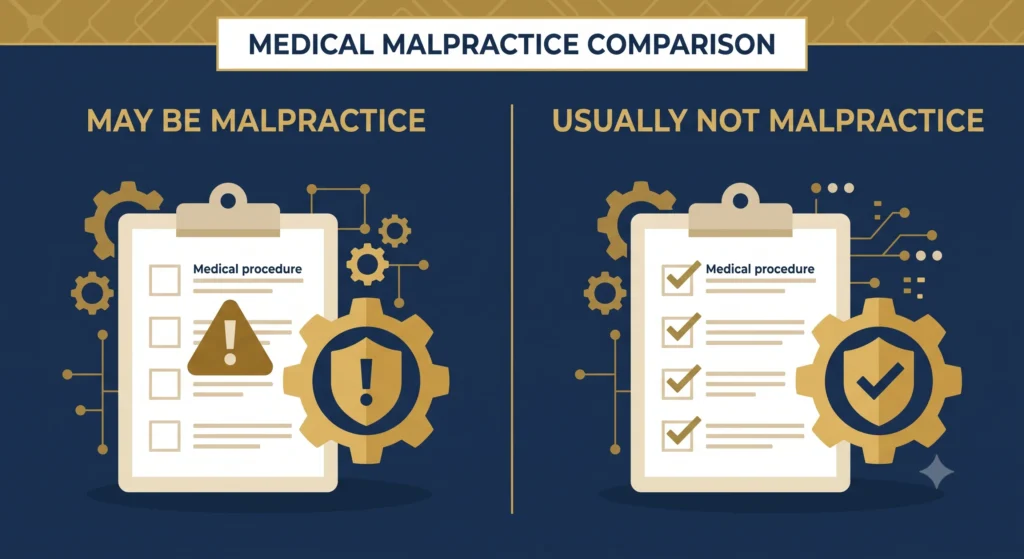
Medical malpractice is a highly specific legal concept. It does not simply mean that a doctor made a mistake, that they were rude, or that you are unhappy with the results of a surgery. For a situation to legally qualify as a medical malpractice claim, four specific elements must be proven. Think of these elements as a chain; if even one link is missing, a legal claim cannot succeed.
1. Duty of Care
The first element is establishing that a doctor-patient relationship existed. When a doctor agrees to treat you, they automatically assume a legal “duty of care.” This simply means they have an obligation to treat you with the same level of skill, care, and diligence that a reasonably competent healthcare professional in the same specialty would use under similar circumstances. Proving this is usually the easiest part of a case—if you were admitted to the hospital, or you had an appointment with a doctor who examined you or prescribed you medication, the duty of care exists.
2. Breach of the Standard of Care (Negligence)
This is where cases become highly complex. To prove malpractice, you must show that the healthcare provider breached their duty of care. In the legal world, this is often called violating the “standard of care.”
The standard of care is not a universal rulebook; it changes based on the patient’s age, the specific medical condition, geographic location, and current medical technology. To prove a breach, you have to establish what a reasonably prudent doctor should have done in that exact scenario, and then demonstrate that your doctor failed to do it. For example, if a patient presents to an emergency room with classic signs of a heart attack, the standard of care dictates running specific cardiac tests. If the doctor sends the patient home with antacids without running those tests, that action likely represents a breach of the standard of care.
3. Causation
Proving that a doctor made a negligent mistake is not enough; you must also prove that their specific mistake is what actually caused your injury. This is often the most heavily contested battleground in a medical malpractice claim.
Because patients seeking medical care are usually already sick or injured, defense attorneys will frequently argue that the patient’s bad outcome was caused by their underlying illness, not by the doctor’s actions. To succeed, you have to show a direct, undeniable link. If a doctor fails to diagnose cancer for six months, you must prove that the six-month delay is what caused the cancer to become terminal, rather than the aggressive nature of the cancer itself.
4. Damages
Finally, the doctor’s negligence must have resulted in quantifiable harm, known in the legal system as “damages.” Even if a doctor breached the standard of care and made an egregious error, you cannot sue for malpractice if you did not suffer actual harm. For instance, if a pharmacist hands you the wrong medication, but you notice the error before taking it, the pharmacist was certainly negligent, but there is no malpractice case because there are no damages. Damages can include physical pain, additional medical bills, lost income, and emotional suffering.
Common Examples That May Indicate Malpractice
While every case is heavily dependent on its specific facts, certain patterns of medical errors are frequently at the center of negligence claims. If your experience aligns with any of the following scenarios, it may indicate medical malpractice and warrants a closer look by professionals.
Misdiagnosis or Delayed Diagnosis
When a serious medical condition is misdiagnosed, completely missed, or diagnosed far too late, the patient loses critical time. This lost time can mean the difference between a simple, effective treatment and a lifetime of disability—or even death. This often occurs when doctors fail to listen to a patient’s symptoms, fail to order the appropriate diagnostic tests, or misinterpret the results of lab work, X-rays, or MRIs. Conditions commonly involved in diagnostic errors include various cancers, heart attacks, strokes, and dangerous infections like sepsis.
Surgical Errors
The operating room is a high-stakes environment where strict protocols must be followed. When surgical teams deviate from these protocols, the results can be catastrophic. Scenarios that may point to malpractice include operating on the wrong body part, leaving surgical instruments or sponges inside the patient’s body cavity, accidentally puncturing nearby healthy organs during a procedure, or serious errors made by the anesthesiologist (such as administering too much or too little anesthesia, leading to brain damage or anesthetic awareness).
Medication Errors
Medication errors can occur at multiple stages of the healthcare process: from the doctor prescribing it, to the nurse administering it, to the pharmacist filling it. These errors may involve prescribing a drug that fatally interacts with another medication the patient is known to be taking, administering an incorrect dosage (such as an overdose of powerful painkillers or blood thinners), or ignoring a patient’s documented allergies to certain pharmaceutical families.
Birth Injuries
The labor and delivery process requires careful, constant monitoring of both the mother and the fetus. If medical staff fail to respond to signs of fetal distress on the heart monitor, fail to order an emergency Cesarean section in a timely manner, or improperly use birthing tools like forceps or vacuum extractors, the infant can suffer permanent harm. Conditions like cerebral palsy, Erb’s palsy, and severe brain damage due to oxygen deprivation (hypoxia) may indicate that the standard of care was breached during the birthing process.
Failure to Obtain Informed Consent
Patients have a fundamental right to make informed decisions about their own bodies. Before performing a procedure, a doctor must inform the patient of the potential risks, the expected benefits, and any viable alternative treatments. If a doctor fails to disclose a significant, known risk of a surgery, and the patient subsequently suffers that exact complication, it may indicate malpractice—provided the patient can show they would have refused the procedure had they been properly informed of the risks.
Examples That Are Usually NOT Malpractice
To help clarify the line between negligence and a tragic reality, it is equally important to understand what generally does not qualify for legal action. The legal system recognizes that medicine is an imperfect science.
Known Risks and Complications That Were Properly Disclosed
Every surgery, medication, and medical procedure carries inherent risks. A patient might develop a severe infection after an abdominal surgery, or suffer from heavy bleeding. If the doctor properly disclosed these possibilities to the patient beforehand, and the complications occurred despite the surgical team performing the procedure flawlessly, this is generally not malpractice. A known complication is only actionable if the complication itself was caused by a negligent act (for example, if the post-operative infection happened because the surgeon used unsterilized tools).
A Treatment Simply Not Working
Doctors cannot guarantee a cure. If a physician properly diagnoses an illness, prescribes a medication or treatment plan that is entirely appropriate according to the current medical standard of care, but the patient’s body simply does not respond to the treatment, there is no negligence. The human body is unpredictable, and the failure of a medically sound treatment plan is a tragedy, not a tort.
Minor Errors with No Real Harm
As mentioned in the definition of “damages,” a mistake without harm does not equal malpractice. If a nurse gives you a meal that violates your temporary hospital dietary restrictions, but it only causes a brief bout of mild indigestion that passes quickly, the error does not rise to the level of actionable malpractice, as the damages are negligible.
How to Get a Preliminary Case Evaluation
If you have reviewed the definitions and feel that your situation may indeed cross the line into negligence, you are likely wondering what to do next. Taking action can feel overwhelming when you are already dealing with physical pain and emotional distress. Taking these steps methodically can help you evaluate your options without rushing.
1. Request Your Complete Medical Records
Your medical records are the foundational evidence of any potential claim. Before a lawsuit is even a thought, you have a legal right under HIPAA to request and receive copies of your complete medical charts, diagnostic imagery, lab results, and surgical notes. It is highly advisable to request these records in a calm, routine manner without threatening legal action to the billing or records department. Having these records in your possession protects the timeline of events.
2. Seek a Second Medical Opinion
Your primary focus must always be your health and safety. If you suspect your current doctor has made a severe error, or if your condition is deteriorating, seek out a completely independent doctor for a second opinion and continued treatment. Do not go to a doctor within the same practice group. A new, unbiased physician can not only help stabilize your health but can also provide a fresh medical perspective on what exactly went wrong with your previous treatment.
3. Consult a Medical Malpractice Lawyer
Medical negligence law is arguably the most complex area of personal injury law. It is not something you can navigate alone or with a general practice attorney. You should seek out a consultation with a dedicated medical malpractice lawyer. Most reputable attorneys in this field offer free, no-obligation initial consultations.
When you bring your medical records to a medical malpractice lawyer, they will typically have an in-house nurse or an external medical expert review the files. They are looking for clear evidence of a breached standard of care. Because these cases are incredibly expensive to take to trial, attorneys are highly selective and will give you a very frank assessment of whether your experience meets the strict legal threshold for a viable case.
The Clock is Ticking: Understanding Statutes of Limitations
One of the most critical factors in any potential legal action is time. In the legal system, there are strict deadlines known as “statutes of limitations” that dictate how long you have to file a lawsuit in court.
These deadlines are strictly enforced. If you attempt to file a lawsuit even one day after the statute of limitations has expired, the court will almost certainly dismiss your case permanently, regardless of how strong your evidence is or how severe your injuries are.
Statutes of limitations for medical negligence are entirely state-dependent. In some states, you may have only one year from the date of the injury to file a claim; in others, you may have two or three years.
Because medical errors are not always immediately obvious—for instance, a surgical sponge left in an abdomen might not cause severe pain until years later—most states implement a “discovery rule.” This rule means the clock may not start ticking on the date the error happened, but rather on the date you discovered, or reasonably should have discovered, that the injury was caused by medical treatment.
However, even the discovery rule has limits, often referred to as a “statute of repose.” This places an absolute, final cap on the timeline (such as five or seven years from the date of the incident), regardless of when the injury was discovered. Because investigating these claims takes months of requesting records and consulting with medical experts, it is crucial not to wait if you suspect wrongdoing.
What Compensation May Cover in a Legitimate Claim
If a legal professional determines that you have a viable claim and you successfully prove your case, the law attempts to make you “whole” again through financial compensation. While no amount of money can undo physical trauma, compensation is designed to provide financial stability and access to the care you need moving forward.
Compensation in these cases is broadly divided into two categories: economic damages and non-economic damages.
Economic damages are meant to cover your out-of-pocket financial losses. These typically include:
- Medical Expenses: This covers the cost of the care required to fix the doctor’s mistake. It includes past hospital bills, but also the projected costs of future surgeries, lifelong physical therapy, home medical equipment, and in-home nursing care if necessary.
- Lost Wages and Earning Capacity: If the injury kept you out of work for six months, you can seek compensation for those lost paychecks. Furthermore, if the injury left you permanently disabled and unable to return to your previous profession, you can seek compensation for the loss of your future earning potential over the course of your lifetime.
Non-economic damages are meant to compensate for the intangible, deeply personal tolls the injury has taken on your life. These may include:
- Pain and Suffering: Compensation for the physical agony and discomfort you endured as a result of the error.
- Mental Anguish: Compensation for the emotional trauma, anxiety, depression, and loss of enjoyment of life.
- Loss of Consortium: In cases of severe, life-altering injuries, the patient’s spouse may be awarded compensation for the loss of companionship, affection, and intimacy.
It is important to note that many states have enacted laws that place strict “caps” or limits on the amount of non-economic damages a jury can award, regardless of how devastating the injury is. An attorney can explain the specific damage caps that apply in your state.
Frequently Asked Questions
1. How long does a malpractice case typically take from start to finish? Because of the immense complexity involved, these are not quick cases. From the initial investigation and gathering of expert witnesses to the discovery phase and potential trial, a typical case can take anywhere from two to four years, and sometimes longer. Patience is unfortunately a necessary part of the process.
2. Can I sue a hospital, or just the individual doctor? This depends heavily on the employment status of the doctor and where the error occurred. In many cases, doctors are independent contractors rather than direct employees of the hospital, meaning the hospital might not be liable for the doctor’s specific decisions. However, if the error was made by a hospital employee—such as a nurse administering the wrong medication, or an X-ray technician mislabeling a scan—the hospital itself can often be held directly liable.
3. What if I signed a waiver or an informed consent form before my surgery? Signing a consent form does not give a doctor a free pass to commit negligence. A consent form simply acknowledges that you accept the known, standard risks of a properly performed procedure. It does not mean you consent to a surgeon making a preventable mistake, operating while intoxicated, or using unsterilized equipment. If the injury was caused by a breach of the standard of care, the consent form will not block a valid claim.
4. Are these cases usually settled out of court, or do they go to trial? Like most civil lawsuits, the majority of medical negligence claims are settled out of court before a trial takes place. Once both sides have presented their expert medical testimonies during the discovery phase, insurance companies will often negotiate a settlement if the plaintiff’s case is strong, in order to avoid the unpredictability of a jury. However, because doctors’ professional reputations are on the line, these cases go to trial more frequently than standard car accident claims.
5. How much does it cost to hire an attorney for this type of case? The vast majority of attorneys handling these claims work on a contingency fee basis. This means you do not pay any upfront hourly fees or retainer costs. The lawyer fronts the heavy costs of the investigation and expert witnesses, and they only get paid if they successfully recover compensation for you (usually taking a pre-agreed percentage of the final settlement or verdict). If you do not win, you generally do not owe the attorney for their time.
6. What if my loved one passed away due to a suspected medical error? If a patient dies as a result of a medical professional’s negligence, the surviving family members (typically a spouse, children, or parents) may be eligible to file a wrongful death lawsuit. While the fundamental requirement to prove malpractice remains exactly the same, the damages sought shift to cover funeral expenses, loss of the deceased’s expected lifetime income, and the family’s loss of companionship and support.
Moving Forward with Clarity
Experiencing a severe medical setback is one of the most stressful events a person can endure. Sorting through medical jargon, trying to understand what went wrong, and dealing with the physical pain can leave you feeling powerless.
Remember that you have the right to ask questions, the right to demand your records, and the right to seek accountability if the standard of care was violated. Take the time you need to focus on your physical recovery, but do not wait too long to seek answers.
Important Disclaimer: The content provided in this article is intended for general educational and informational purposes only. It does not constitute legal or medical advice. Because medical outcomes and the laws governing them are highly complex and vary significantly by jurisdiction, reading this article does not create an attorney-client or doctor-patient relationship. If you suspect you have been the victim of negligence, you should immediately consult a licensed medical professional for a second opinion regarding your health, and contact a qualified attorney in your state to discuss the specific facts of your situation.
