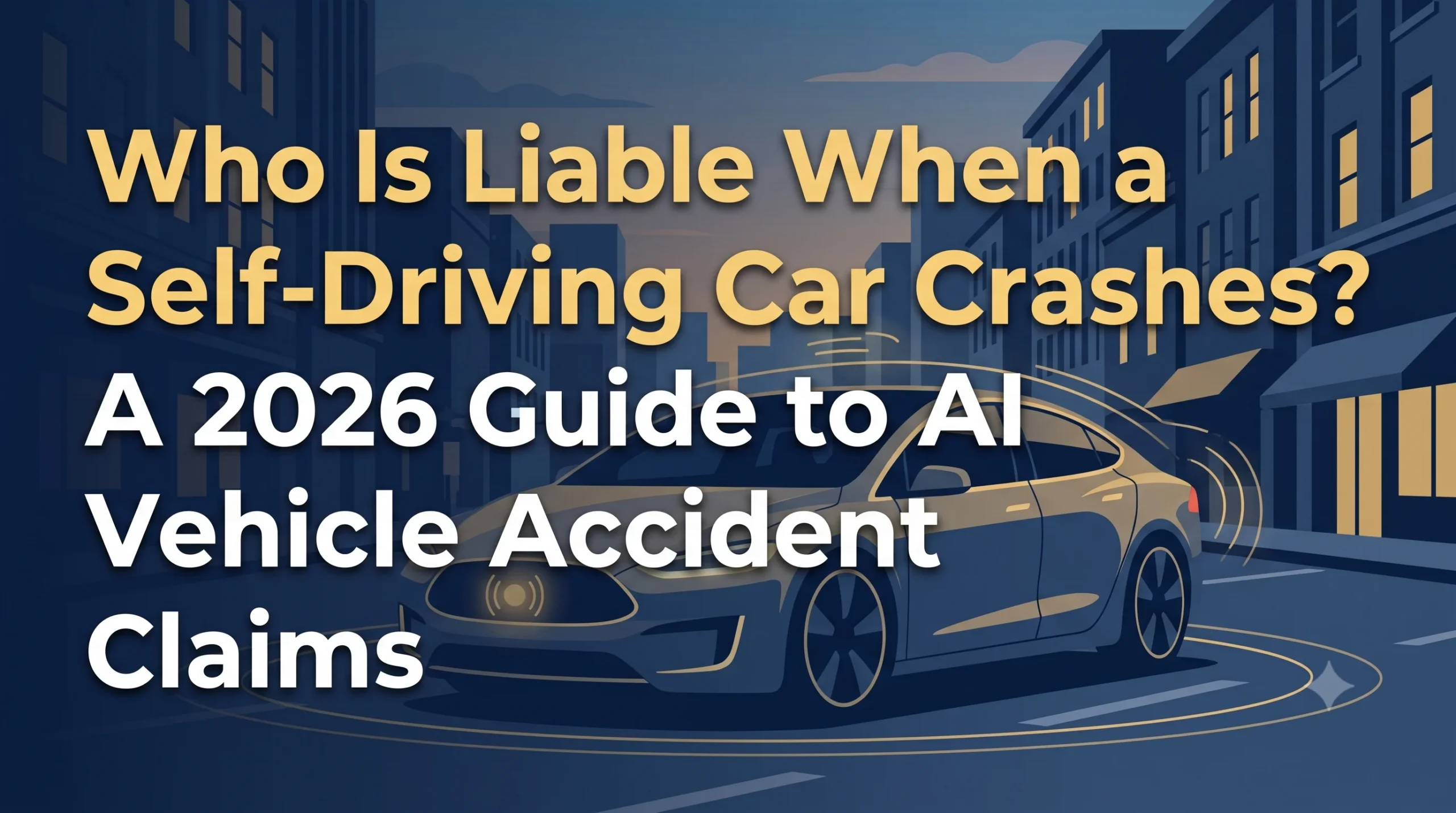
Who Is Liable When a Self-Driving Car Crashes? A 2026 Guide to AI Vehicle Accident Claims
Picture this: You are driving home on a Tuesday evening. The traffic is moving smoothly when, out of nowhere, a driverless taxi swerves into your lane to avoid a piece of debris, sideswiping your sedan and pushing you into a guardrail. You are injured, your car is severely damaged, and when you get out to exchange insurance information, you look through the window of the other vehicle and realize there is absolutely no one in the driver’s seat.
A decade ago, this scenario was pure science fiction. Today, it is a reality unfolding on city streets from San Francisco to Phoenix to Miami.
As of 2026, autonomous vehicles are sharing our roads in record numbers. But when these vehicles cause property damage or severe injuries, the legal aftermath turns into a tangled web. For a century, the question of fault in a car crash was usually answered by figuring out which human made a mistake. Did the driver speed? Were they texting? Did they run a red light? Now, the question is entirely different: What if the entity that made the mistake wasn’t a human, but a string of code?
Understanding self-driving car accident liability is rapidly becoming one of the most critical issues in modern personal injury law. If you or a loved one have been involved in a collision with an autonomous vehicle, you are likely wondering who is going to pay for your medical bills, lost wages, and pain. Will it be the person sitting in the passenger seat playing on their phone? The massive tech company that programmed the AI? Or the car manufacturer that built the sensors?
This comprehensive guide breaks down exactly how the legal system is currently handling an AI car accident claim, how liability is divided, and what evidence you need to prove your case.
The Core Problem: How Is Liability Actually Determined?
When a standard car crash happens, lawyers and insurance adjusters rely on the concept of “negligence.” A driver owes a duty of care to everyone else on the road. If they breach that duty by acting carelessly, and that breach causes harm, they are financially responsible.
But applying the traditional rules of human negligence to artificial intelligence simply does not work. You cannot sue an algorithm. You cannot depose a software update. Instead, the legal framework has to pivot from standard auto negligence to a much more complex area of law: product liability.
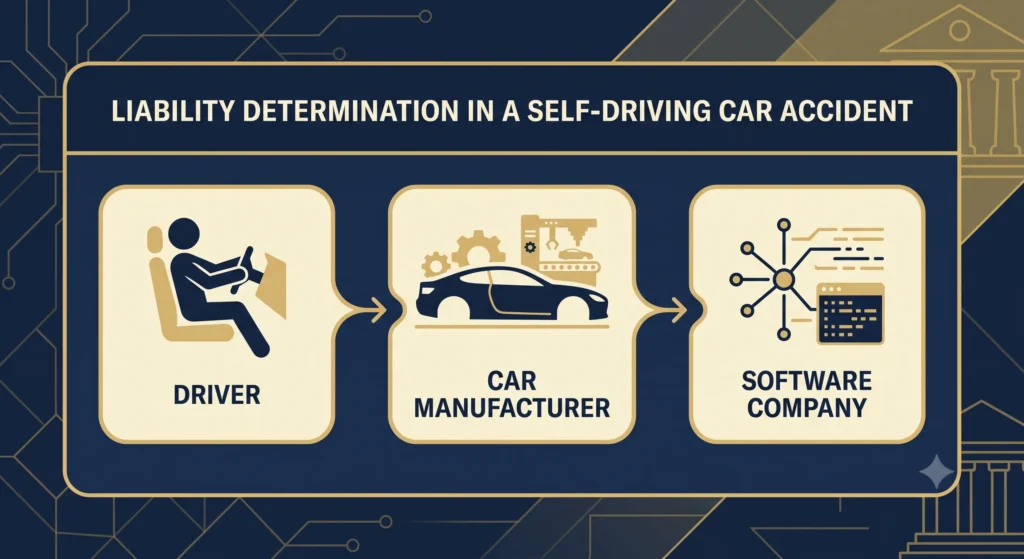
When determining who is at fault for an autonomous vehicle crash, attorneys generally look at three primary targets.
1. The Human Driver (or “Operator”)
In many cases involving partially automated cars, the human sitting behind the wheel is still legally at fault. If a vehicle requires the human to supervise the driving and take over in an emergency, that human is considered the legal operator. If they fail to brake because they were distracted by a movie or fell asleep, their own auto insurance policy is going to be the primary target for compensation.
2. The Vehicle Manufacturer
If a critical physical component of the car fails—such as a LIDAR sensor, a camera lens, or the braking mechanism itself—the manufacturer (e.g., Ford, General Motors, Audi) could be held strictly liable under product liability laws. Strict liability means the victim does not necessarily have to prove that the manufacturer was careless; they only need to prove that the car was inherently defective or unreasonably dangerous when it left the assembly line, and that defect caused the crash.
3. The Software or Tech Company
Increasingly, the software that powers the vehicle is created by a separate tech entity entirely. If a bug in the vehicle’s decision-making algorithm misidentifies a pedestrian as a plastic bag and fails to stop, the software developer could be on the hook. Pursuing an AI car accident claim against a multi-billion-dollar tech conglomerate requires showing that the software was flawed in its design or failed to interpret the environment safely.
The Crucial Divide: Level 2/3 Driver Assist vs. Level 4/5 Full Self-Driving
To figure out who is liable, you first have to understand what type of vehicle was actually involved. The Society of Automotive Engineers (SAE) classifies vehicle automation on a scale from Level 0 to Level 5. The legal responsibility shifts dramatically depending on where the car falls on this spectrum.
Levels 2 and 3: The Human is the Backup
Level 2 (Partial Automation) and Level 3 (Conditional Automation) vehicles are everywhere right now. These systems can steer, accelerate, and brake under specific conditions—like highway cruising or traffic jams.
However, the golden rule of Level 2 and Level 3 is that the human driver must remain alert and ready to take control at a split second’s notice. Because the human is the designated failsafe, the legal burden usually rests squarely on their shoulders. If the vehicle’s system suddenly disengages and the human driver is caught off guard, the courts have consistently ruled that the human is responsible for the resulting crash. The only exception is if the victim’s autonomous vehicle accident lawyer can explicitly prove the system actively prevented the human from taking over, or failed in a way that was entirely unpredictable.
Levels 4 and 5: True Autonomy
Level 4 (High Automation) and Level 5 (Full Automation) represent a total shift in the legal landscape. At these levels, the vehicle handles all driving tasks. In fact, many Level 4 robotaxis do not even have steering wheels or pedals.
In crashes involving Level 4 or Level 5 vehicles, the human passengers are legally treated like passengers on a train or a bus. They have zero control over the vehicle’s operation. Therefore, self-driving car accident liability shifts almost entirely to the fleet operator, the software developer, or the vehicle manufacturer. If a fully driverless taxi hits you in a crosswalk, you are not suing the confused passenger sitting in the back seat; you are filing an AI car accident claim directly against the corporate entity that deployed the vehicle.
Real-World Examples: How These Crashes Happen
While we cannot dive into the specific details of ongoing, confidential litigation, looking at the general types of incidents involving major players like Tesla, Waymo, and Cruise helps illustrate how these accidents manifest in the real world.
The “Over-Reliance” Crash (Common with Consumer ADAS)
Many consumers purchase vehicles with advanced driver assistance systems (ADAS) believing the cars are fully autonomous. They turn the system on, take their hands off the wheel, and stop paying attention. A common crash profile involves a vehicle operating at highway speeds failing to recognize a stationary object—like a stopped firetruck or a stalled semi-trailer—because the radar system filters out static objects to prevent false braking. The car crashes at full speed because the human driver wasn’t looking. In these cases, liability almost always falls on the distracted driver, though some plaintiffs have attempted to sue the automaker for deceptive marketing practices.
The “Edge Case” Robotaxi Crash
Robotaxis operate heavily in dense urban environments. While they are generally very cautious, they sometimes struggle with “edge cases”—bizarre, unexpected scenarios that a human would navigate easily through intuition. For example, a robotaxi might become confused by temporary construction barriers, erratic pedestrians, or emergency vehicles entering an intersection against the light. If a fully driverless vehicle abruptly stops in the middle of a high-speed intersection because its sensors get confused by a reflection, causing a multi-car pileup, the fleet operator is typically the target for liability.
The “Phantom Braking” Incident
Another frequent issue across all levels of automation is “phantom braking.” This occurs when the vehicle’s sensors falsely detect an obstacle that isn’t there—like a shadow on the road—and slams on the brakes forcefully, causing the human driver behind them to rear-end the autonomous vehicle. Sorting out fault here is tricky. Generally, the car in the back is at fault for following too closely, but an autonomous vehicle accident lawyer might argue that the sudden, aggressive, and unjustified braking of the AI vehicle creates shared liability.
How Insurance Companies Handle AI Vehicle Claims
If you get into a fender bender with a regular car, the insurance process is fairly straightforward. You file a claim, an adjuster looks at the police report, assesses the vehicle damage, and cuts a check.
Dealing with an AI car accident claim is an entirely different beast. Insurance adjusters treat these cases with immense scrutiny because the financial stakes are massive, and the legal precedent is still being written.
When a tech company’s driverless car is involved, they usually rely on massive commercial liability policies rather than standard auto insurance. These corporate insurers are armed with teams of defense attorneys whose sole job is to protect the company’s reputation and bottom line. They will often argue that the crash was unavoidable, that a human driver would have made the same mistake, or that you (the victim) were partially at fault for not reacting fast enough to the AI vehicle’s maneuvers.
Because corporate entities fiercely protect their proprietary algorithms, their insurance adjusters are rarely eager to admit fault quickly. They know that settling a claim too easily might set a bad precedent for future crashes. This is why having strong, undeniable evidence is the only way to win these claims.
The Evidence That Matters in an Autonomous Crash
In a normal crash, you rely on witness statements, skid marks, and police reports. In a self-driving car crash, the most vital evidence is invisible. It is hidden deep within the vehicle’s internal computers.
Telematics and Event Data Recorders (EDRs)
Modern cars are essentially rolling supercomputers. They are equipped with black boxes, or Event Data Recorders, which capture crucial data in the seconds leading up to a crash. An autonomous vehicle accident lawyer will immediately file a preservation letter to legally force the manufacturer to save this data. The EDR will show exactly how fast the car was going, whether the brakes were applied, what the steering angle was, and most importantly, whether the autonomous system was engaged at the moment of impact.
Sensor and LIDAR Data
Driverless vehicles use an array of cameras, radar, and LIDAR (light detection and ranging) to “see” the world. This sensor data paints a 3D picture of the environment just before the crash. Securing this data can prove that the vehicle’s computer actually “saw” you but the software failed to command the brakes in time.
Over-The-Air (OTA) Update Logs
Self-driving software is updated over the internet, just like your smartphone. Sometimes, a recent OTA update introduces a bug into the braking or steering logic. Investigating the vehicle’s software version and comparing it to known patches or recalls can be the smoking gun in a product liability claim.
Steps a Victim Should Take After the Accident
If you are involved in a collision with a vehicle operating on any level of autonomy, the steps you take in the immediate aftermath are critical to protecting your rights.
- Call 911 Immediately: You need a formal police report. Ensure the responding officer notes in the report that the other vehicle was operating autonomously or was a driverless model.
- Seek Medical Attention: Adrenaline masks pain. Go to the hospital or urgent care immediately. Insurance companies will use any gap in medical treatment to argue your injuries aren’t serious.
- Document Everything You Can: Take photos of the vehicles, the license plates, the road conditions, and any visible cameras or sensors on the autonomous car. If the car has no driver, take a video showing the empty cabin.
- Identify Witnesses: AI systems process data, but human witnesses provide context. Get the names and phone numbers of anyone who saw the erratic behavior of the vehicle before the crash.
- Do Not Speak to the Corporate Reps: If a driverless taxi is involved, the tech company’s rapid response team might reach out to you very quickly. Do not give a recorded statement. They are looking for soundbites to minimize their liability.
- Consult Legal Counsel: Self-driving car accident liability is incredibly complex. You need a professional who understands how to subpoena digital telemetry data.
A Note on the Statute of Limitations
If you intend to file a lawsuit, you do not have unlimited time. The legal clock starts ticking the moment the accident occurs. This deadline is known as the statute of limitations, and it dictates how long you have to file a claim before you lose your right to seek compensation forever.
It is crucial to understand that the statute of limitations varies wildly by state. In states like California or Texas, you generally have two years from the date of the crash to file a personal injury lawsuit. In places like Florida, recent legislative changes have altered the timelines, while other states may allow up to three or four years. Furthermore, if the vehicle was operated by a public transit authority or a government-subsidized program, the deadline to file an initial administrative claim could be as short as 60 to 90 days. Never make assumptions about your timeline without consulting local regulations.
Frequently Asked Questions (People Also Ask)
Can I sue the software company if an AI car hits me?
Yes, you can potentially sue the software company, but it falls under complex product liability laws. You and your legal team would need to prove that the software was defective in its design or failed to interpret sensor data correctly, and that this defect was the direct cause of your injuries.
What happens if a self-driving car kills someone?
If an autonomous vehicle causes a fatal accident, the surviving family members can file a wrongful death claim. Depending on the level of autonomy (Level 2 vs. Level 5), the liable party could be the human “safety driver” who failed to intervene, the vehicle manufacturer, or the fleet operator. Settlements and jury verdicts in wrongful death cases involving corporate tech defendants can range from hundreds of thousands to several million dollars, depending on the specific circumstances and state laws.
Does my normal auto insurance cover an accident with a driverless car?
Yes. If you carry uninsured/underinsured motorist (UM/UIM) coverage, or collision coverage, your own insurance will step in to cover immediate medical bills or property damage while the complex liability dispute plays out between your provider and the tech company’s commercial insurers.
Who gets the ticket in a self-driving car accident?
This is currently a massive gray area in traffic law. If the car requires a human driver (Level 2/3), the human gets the citation. If the car is a fully driverless Level 4 robotaxi, police officers technically cannot issue a moving violation to an empty seat. In these cases, the company may face regulatory fines from the state transportation department rather than a traditional traffic ticket.
How much does an autonomous vehicle accident lawyer cost?
The vast majority of personal injury attorneys who handle these complex cases work on a contingency fee basis. This means you do not pay any upfront hourly fees. The law firm covers the cost of hiring software experts and accident reconstructionists, and they only take a percentage of the final settlement or court award if they win your case.
Are self-driving cars safer than human drivers?
The data is continually evolving. While companies argue that their sensors never get drunk, tired, or distracted, the software still struggles with unpredictable human behavior, bad weather, and complex construction zones. Statistically, AI vehicles excel on predictable highways but still experience high rates of minor collisions in dense urban centers.
Legal Disclaimer: The information provided in this article is intended for general informational and educational purposes only. It does not constitute legal, financial, or insurance advice. State laws regarding autonomous vehicles, liability, and statutes of limitations are changing rapidly. Reading this guide does not create an attorney-client relationship. If you have been involved in an accident, you should strongly consider consulting with a licensed, qualified personal injury attorney in your specific state to evaluate the unique facts of your case.