E-Scooter and Rideshare Injury Claims: What Uber, Lyft, and Bird Accident Victims Need to Know in 2026
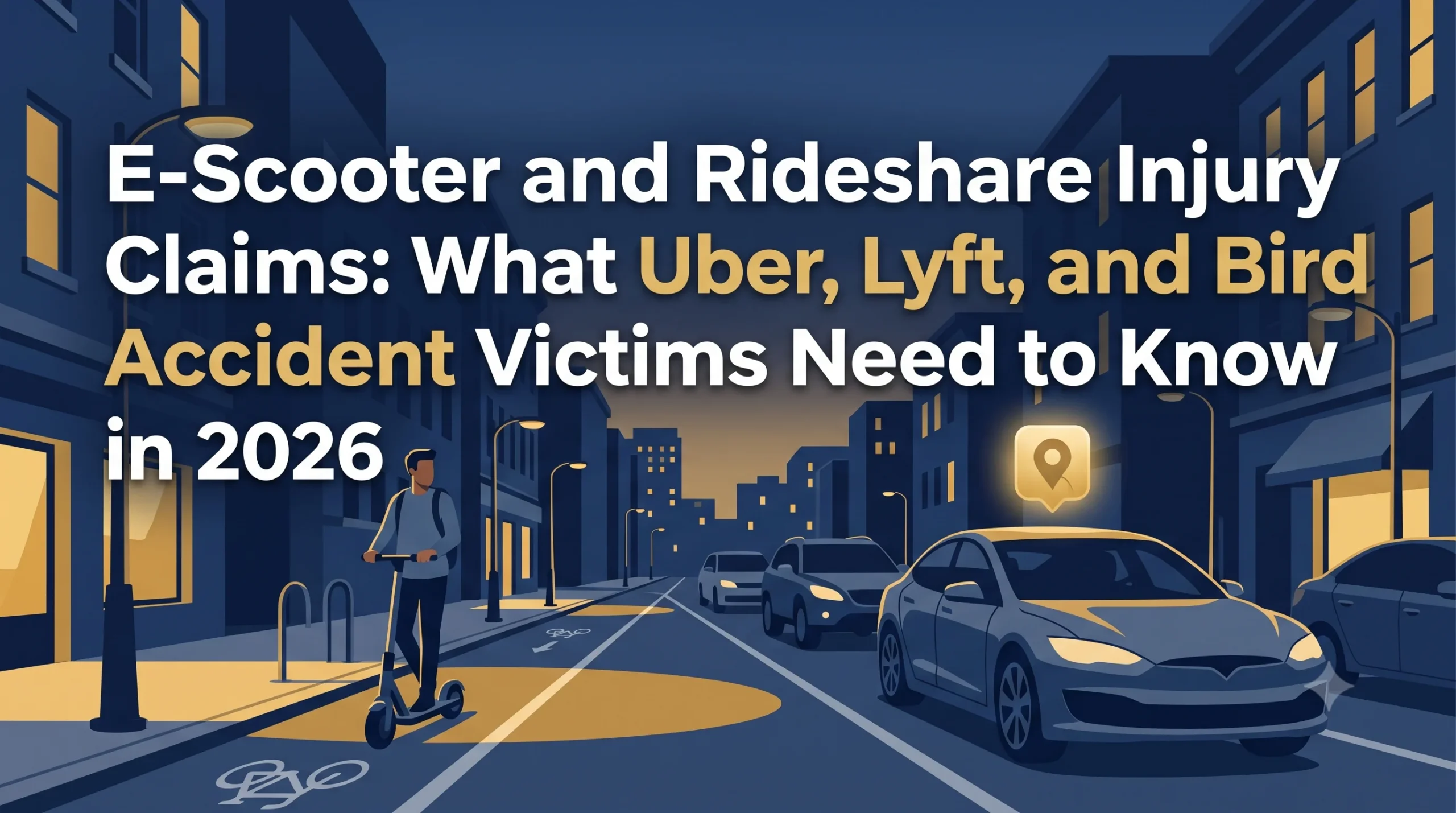
Picture this: It is 5:15 PM on a crisp autumn evening in the heart of downtown. Streetlights are flickering on, traffic is crawling bumper-to-bumper, and dozens of commuters are hurrying across crosswalks. On one side of the avenue, a rushed Uber driver glances down at a dashboard-mounted smartphone to confirm a pickup route. On the other side, a commuter steps onto a docked Bird electric scooter, twists the throttle, and pulls into the bike lane. Seconds later, a delivery truck slams on its brakes, the Uber driver swerves across the lane line, and the e-scooter rider is thrown headfirst onto the asphalt.
Scenes like this unfold in hundreds of American cities every single day. Over the past decade, urban transportation has undergone a quiet revolution. Traditional personal car ownership in major metro areas has yielded ground to a hybrid ecosystem driven by micromobility rentals—such as Bird, Lime, and Spin—and transportation network companies (TNCs) like Uber and Lyft.
While these platforms offer undeniable convenience, they have also created a chaotic, high-density traffic dynamic. As electric scooters navigate the perilous gray zone between pedestrian sidewalks and motor vehicle lanes, and as millions of rideshare vehicles crisscross city grids under the pressure of timed dispatch algorithms, serious collisions have become an unavoidable reality.
Navigating the legal aftermath of an accident involving a rideshare vehicle or an app-based electric scooter is vastly different from handling a standard two-car fender bender. Multiple corporate entities, complex multi-tiered insurance policies, evolving municipal regulations, and digital telemetry data all intersect in these modern personal injury claims. Whether you were riding a scooter, riding as an Uber or Lyft passenger, or walking across a street when a vehicle struck you, understanding how liability and insurance coverage work in 2026 is critical to protecting your health and financial future.
About Our Legal Research & Credibility
Editorial Note & Methodology: This comprehensive guide was researched, drafted, and verified by our senior legal publishing team, which specializes in personal injury, tort liability, and emerging transportation law. Our content is built upon an in-depth analysis of modern state motor vehicle statutes, corporate terms of service agreements for major TNCs and micromobility operators, commercial auto policy structures, and prevailing judicial precedents across state and federal courts. We regularly analyze how evolving technology affects personal injury litigation to provide clear, actionable, and objective educational guidance for accident victims.
Types of E-Scooter Accidents: Rider vs. Pedestrian vs. Vehicle Collisions
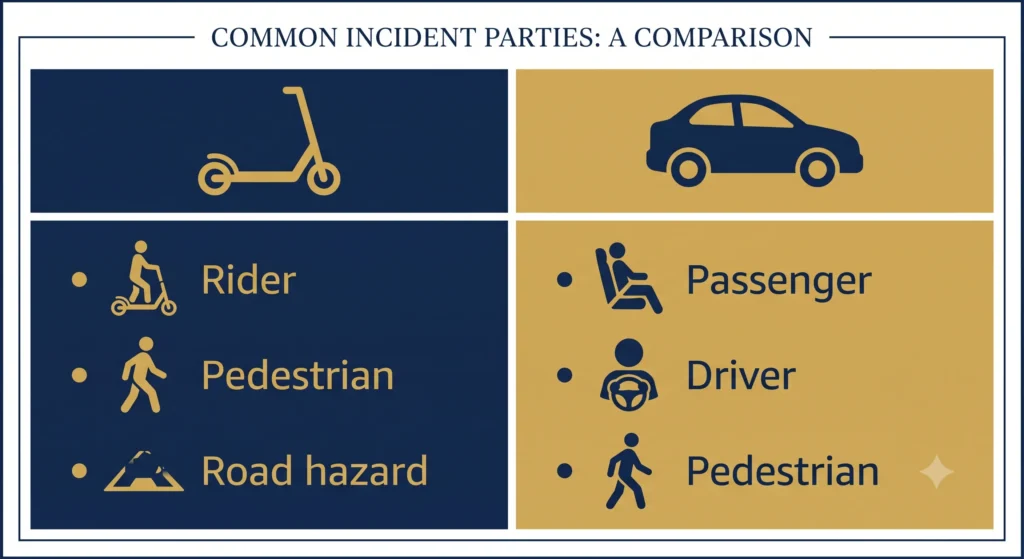
Electric scooters are deceptively fast. Most commercial rental models can reach speeds between 15 and 20 miles per hour. Because riders are entirely exposed—lacking the steel cage, airbags, and seatbelts of a passenger car—the physical forces involved in a crash almost always lead to severe bodily injuries. In legal practice, e-scooter accidents generally fall into three distinct categories, each carrying its own legal dynamics.
+———————————————————————–+
| TYPES OF E-SCOOTER ACCIDENTS |
+————————————+———————————-+
| Incident Type | Primary Risk Factors |
+————————————+———————————-+
| E-Scooter vs. Motor Vehicle | Dooring, blind turns, swerving |
| E-Scooter vs. Pedestrian | Sidewalk riding, crosswalks |
| Solo Rider / Hardware Defect | Brake failure, sudden battery lock|
+————————————+———————————-+
1. E-Scooter Rider vs. Motor Vehicle Collisions
Collisions between e-scooter riders and passenger automobiles or commercial trucks are frequently the most catastrophic incidents on city streets. Drivers accustomed to looking out for full-sized passenger cars often fail to spot a narrow, fast-moving scooter in their side mirrors or blind spots. Common collision scenarios include:
- “Dooring” Incidents: A parked driver opens their car door directly into the path of an oncoming e-scooter rider who has no time or space to dodge the door.
- Right-Hook Turns: A motorist accelerates past an e-scooter traveling in a bike lane and makes an immediate right turn across the rider’s path at an intersection.
- Unsignalized Lane Merges: A motor vehicle merges into a designated bike or transit lane without checking for micromobility traffic.
In these cases, impact injuries—such as traumatic brain injuries (TBIs), complex bone fractures, spinal trauma, and extensive road rash—are common for the unprotected scooter rider.
2. E-Scooter vs. Pedestrian Collisions
When e-scooters are operated on crowded sidewalks or through pedestrian plazas, the danger shifts to innocent bystanders. Elderly individuals, small children, and visually impaired pedestrians are especially vulnerable to being struck from behind or knocked over by fast-moving scooters.
Legally, these cases turn on local municipal ordinances. In many cities, riding an electric scooter on a pedestrian sidewalk is strictly illegal; riders are legally required to use dedicated bike lanes or ride along the right-hand edge of the roadway. When a rider violates a local ban on sidewalk riding and injures a pedestrian, that statutory violation can serve as compelling evidence of negligence under the legal doctrine of negligence per se.
3. Solo Rider Accidents & Defective Equipment Crashes
Not all e-scooter crashes involve another human being. A significant portion of injury claims stems from single-rider wipeouts caused by hardware failures, mechanical defects, or software malfunctions. Common causes include:
- Sudden wheel lockups triggered by remote geofencing or software glitches.
- Brake line failure or worn-out friction pads on public rental fleets.
- Steering column snapping or handlebar detachment during normal operation.
- Battery fires or short circuits.
When a crash occurs without any third-party vehicle involved, liability often shifts away from traffic laws and into the realm of product liability and fleet maintenance negligence.
Who Can Be Held Liable in E-Scooter Cases?
Determining who is financially and legally responsible for an e-scooter injury requires investigating every factor that contributed to the incident. Depending on the circumstances, one or more parties may share legal fault.
+———————————————–+
| POTENTIAL LIABLE PARTIES IN E-SCOOTER |
| ACCIDENTS |
+———————–+———————–+
|
+——————-+———–+———–+——————-+
| | | |
v v v v
+————+ +—————+ +—————+ +—————+
| Negligent | | E-Scooter | | City / | | E-Scooter |
| Driver | | Rider | | Municipality | | Platform |
| (Motorist) | | (Comparative) | | (Road Defects)| | (Product/ |
+————+ +—————+ +—————+ | Maintenance) |
+—————+
The Scooter Rider
If a rider behaves recklessly—such as traveling at excessive speeds through a pedestrian crowd, ignoring traffic signals, riding under the influence of alcohol or drugs, or carrying a passenger on a single-user scooter—they can be held personally liable for injuries caused to pedestrians or other road users. However, if the rider was injured due to another person’s actions, their own minor mistake might not completely bar recovery, depending on whether the state follows comparative or contributory negligence rules.
The E-Scooter Rental Company (Bird, Lime, Spin, etc.)
When riders sign up for a micromobility app, they agree to lengthy liability waivers and user agreements. These contracts usually contain strict arbitration clauses and language shifting maintenance obligations onto the user. However, these liability waivers are not impenetrable shields.
A fleet operating company can still be held liable under theories of product liability (if the scooter had an inherent design or manufacturing flaw) or negligent fleet maintenance (if the company failed to inspect, repair, or decommission a scooter after receiving prior safety complaints or telemetry warnings). Working with a skilled e-scooter injury lawyer is often necessary to challenge broad liability waivers and obtain internal company maintenance records.
Municipalities and Local Government Entities
Dangerous road conditions are a leading cause of micromobility crashes. Potholes, unpaved utility cuts, missing drain grates, obscured stop signs, and poorly designed streetcar tracks can instantly throw an e-scooter rider from their deck.
If a city or local government agency failed to repair a known road hazard within a reasonable time, the injured victim may have grounds for a personal injury claim against the municipality. However, bringing a claim against a public entity involves strict procedural requirements. Most jurisdictions require victims to file a formal “Notice of Claim” within a very tight window—sometimes as short as 30 to 90 days following the crash—or forfeit their right to compensation entirely.
Third-Party Motorists
When a negligent motor vehicle driver strikes an e-scooter rider or cuts them off, the driver’s standard auto insurance policy serves as the primary source of financial recovery. Proving liability against a motorist follows standard personal injury principles: establishing that the driver owed a duty of care, breached that duty through distraction, speeding, or failing to yield, and directly caused the victim’s injuries.
Rideshare-Specific Injury Scenarios: Uber and Lyft Crashes
Rideshare collisions present unique legal challenges because the driver is an independent contractor operating a personal vehicle for commercial gain. Understanding your legal rights after an Uber or Lyft crash largely depends on your role at the time of the incident.
Passenger Injury During a Trip
As a paying passenger inside an Uber or Lyft, you occupy a unique legal position: you almost certainly bear zero percent fault for the crash. Whether your driver ran a red light or another motorist rear-ended your rideshare vehicle, your claim is fundamentally about securing compensation from the responsible insurance coverage.
However, receiving fair compensation is rarely seamless. The rideshare company’s commercial insurer and the third-party driver’s personal insurer will frequently blame each other for the impact, attempting to delay payments or reduce the settlement value of your injuries.
Driver Assault, Harassment, or Negligence Claims
Beyond physical traffic accidents, rideshare passengers sometimes suffer injuries resulting from driver assault, physical attack, or extreme negligence. In these scenarios, claims extend beyond simple motor vehicle accident law.
Litigation against rideshare giants often centers on negligent hiring, retention, and background check failures. Plaintiffs may allege that the company failed to properly screen a driver’s criminal record, ignored previous customer safety reports, or failed to enforce adequate safety protocols within the app ecosystem.
Pedestrians, Cyclists, and Other Drivers Hit by a Rideshare Vehicle
If an Uber or Lyft driver collides with your vehicle, knocks you off your bicycle, or hits you in a crosswalk, your ability to recover full compensation hinges entirely on the driver’s exact “app status” at the exact second the impact occurred.
Decoding Rideshare Company Insurance Policies: The Three Phases
The single most critical factor in any Uber Lyft accident claim is determining the active coverage phase of the rideshare driver at the time of the accident. Federal and state regulations require TNCs to maintain multi-layered insurance structures that shift dynamically depending on how the driver is using the mobile application.
+—————————————————————————————————+
| RIDESHARE INSURANCE COVERAGE PHASES |
+———————–+———————————-+—————————————-+
| App Status | Phase / Period | Insurance Coverage Available |
+———————–+———————————-+—————————————-+
| App OFF | Off-Duty / Phase 0 | Driver’s Personal Auto Insurance Only |
| App ON (Searching) | Period 1 (Waiting for Request) | Contingent Liability ($50k/$100k/$25k) |
| Match Accepted / Trip | Period 2 & Period 3 (En Route / | Up to $1,000,000 Commercial Policy + |
| In Progress | Passenger on Board) | UM/UIM Coverage |
+———————–+———————————-+—————————————-+
Phase 0: The App is Turned Off
If the driver is operating their vehicle with the Uber or Lyft app turned completely off, they are simply driving a personal vehicle.
- Primary Insurance: The driver’s personal automobile policy.
- Corporate Insurance: $0. Neither Uber nor Lyft provides any coverage or legal defense during this phase.
- Common Challenge: Many personal auto policies contain a “commercial use exclusion.” If the insurer discovers the vehicle was being used for commercial purposes, they may attempt to deny coverage altogether, leaving the victim to look for alternative insurance options.
Phase 1: App is On, Waiting for a Ride Request
The driver has logged into the app and is actively looking for a passenger, but has not yet accepted a ride match.
- Primary Insurance: The driver’s personal auto insurance remains primary, but personal carriers almost universally deny these claims due to commercial exclusion clauses.
- Corporate Insurance Coverage: Once the personal carrier denies the claim, the TNC’s contingent liability policy activates. Under current industry standards, this policy provides minimum coverage caps of:
- $50,000 for bodily injury per person.
- $100,000 for total bodily injury per accident.
- $25,000 for property damage.
Phase 2 & Phase 3: Match Accepted and Passenger on Board
- Phase 2: The driver has accepted a ride request and is en route to pick up the passenger.
- Phase 3: The passenger has entered the vehicle, and the trip is actively underway until the driver completes the drop-off in the app.
During Phases 2 and 3, the rideshare platform’s full commercial insurance policy applies. In most jurisdictions, this policy provides up to $1,000,000 in third-party liability coverage. This policy covers injured passengers, pedestrians, cyclists, and occupants of other vehicles struck by the rideshare driver. Additionally, TNCs generally maintain Uninsured/Underinsured Motorist (UM/UIM) coverage during these active phases to protect passengers if another uninsured driver causes the crash.
Because of these drastic coverage differences, an experienced rideshare accident lawyer will immediately file formal preservation letters to secure time-stamped server data proving the driver’s exact app status at the moment of collision.
Digital Evidence Unique to E-Scooter and Rideshare Claims
Unlike standard traffic crashes—which traditionally rely on police reports, physical skid marks, and eye-witness statements—micromobility and rideshare cases generate a rich trail of digital evidence. This electronic data often makes or breaks a claim.
+————————————————————————-+
| DIGITAL EVIDENCE CHECKLIST |
+————————–+———————————————-+
| Evidence Type | What It Proves |
+————————–+———————————————-+
| GPS & Telemetry Logs | Exact speed, trajectory, & impact location |
| App Status Timestamps | Applicable insurance policy period (1 vs 2/3)|
| Hardware Diagnostics | Pre-existing brake, wheel, or battery flaws |
| In-Vehicle Dashcam | Visual record of driver focus & road conditions|
+————————–+———————————————-+
1. App Trip Logs and Server Timestamp Data
Rideshare and e-scooter applications record activity second-by-second. Server logs show the exact moment a trip was requested, accepted, initiated, and terminated. In rideshare litigation, this data establishes whether Period 1, 2, or 3 insurance coverage applies.
2. Telemetry Data and Onboard Sensors
Modern commercial e-scooters are equipped with onboard GPS, gyroscopes, accelerometers, and cellular transceivers. This hardware records:
- The scooter’s precise speed and trajectory leading up to the impact.
- Sudden deceleration events indicating braking or collision force.
- Geofencing commands sent by the server (e.g., automated speed throttles or sudden motor shutoffs).
3. Fleet Maintenance and Inspection Records
Scooter rental companies maintain digital databases tracking every vehicle’s service history, user error reports, battery health metrics, and repair logs. Obtaining these records can reveal whether a company re-deployed a dangerous or defective scooter without completing necessary safety repairs.
4. Dashcam Footage and Smart City Cameras
Many rideshare drivers operate dual-facing dashboard cameras that record both the road ahead and the vehicle interior. Furthermore, because these accidents frequently happen at busy urban intersections, surveillance footage from municipal traffic cameras, residential smart doorbells, and storefront security systems can often be retrieved if requested promptly.
What to Do Immediately After an Incident: A Step-by-Step Checklist
Taking clear, decisive steps immediately after an e-scooter or rideshare crash can protect your health and preserve your legal options.
[1] Ensure Safety & Seek Immediate Medical Attention
│
▼
[2] Call 911 & Ensure an Official Police Report Is Filed
│
▼
[3] Photograph Scene, Machinery, Vehicle Damage, & QR Codes
│
▼
[4] Preserve Digital Evidence (Screenshots, Trip Receipts, Apps)
│
▼
[5] Avoid Early Recorded Statements or Fast Settlement Offers
│
▼
[6] Consult an Attorney Specializing in Micromobility & Rideshare Claims
Step 1: Prioritize Safety and Medical Evaluation
Check yourself and others for injuries. Call emergency services immediately. Even if you feel fine at the scene, seek medical evaluation at an emergency room or urgent care center. Adrenaline frequently masks severe soft-tissue damage, internal bleeding, and concussion symptoms. A prompt medical evaluation creates an official link between the crash and your injuries.
Step 2: Call Law Enforcement
Always request a police officer to the scene to file an official accident report. Ensure the responding officer interviews all involved parties, documents the exact position of vehicles or scooters, and notes any statements of fault.
Step 3: Document the Scene Thoroughly
If you are physically able to do so safely:
- Take wide-angle and close-up photographs of all vehicles involved, road hazards, traffic signals, weather conditions, and visible injuries.
- If an e-scooter is involved, photograph the scooter’s unique QR code, vehicle ID number, and mechanical state (e.g., brake lines, tire condition).
- Take pictures of vehicle license plates, driver’s licenses, and insurance cards.
Step 4: Preserve Digital Evidence
Do not delete the rideshare or e-scooter app from your smartphone. Immediately take screenshots of:
- Your active trip screen showing the driver’s name, vehicle details, route map, and fare receipt.
- Your e-scooter rental confirmation, ride duration, and payment summary.
- Any messaging or communication within the app between you and the driver or support team.
Step 5: Avoid Early Statements to Insurance Adjusters
In the days following a crash, insurance claims adjusters from the rideshare platform or vehicle insurance companies will likely call you. They may sound helpful, but their goal is to minimize corporate financial liability. Do not give a recorded statement or sign any liability release forms until you have reviewed your rights with a qualified legal professional.
Step 6: Consult Qualified Legal Counsel
Consulting an experienced attorney who understands the complexities of app data preservation, corporate insurance phases, and municipal notice deadlines can help level the playing field against insurance carriers and corporate legal teams.
Frequently Asked Questions (FAQ)
1. Can I sue Bird or Uber directly if I was injured as a passenger or pedestrian?
You can generally file an insurance claim against the coverage policies provided by these companies. However, directly suing corporations like Uber or Bird in court for the actions of their drivers or riders is more complex. Rideshare drivers operate as independent contractors, which generally shields TNCs from direct vicarious liability for routine driver negligence. Direct lawsuits against the company usually require proving independent corporate negligence—such as negligent driver screening, unsafe app design, or deploying a known defective e-scooter.
2. What happens if an e-scooter rider hits me on the sidewalk and flees the scene?
An incident where a rider hits a pedestrian and leaves the scene is treated legally as a hit-and-run. You should immediately call the police to file a report. Law enforcement can request app trip data and local security footage from the rental company to identify the rider. Furthermore, depending on your state and auto policy terms, your personal auto policy’s Uninsured Motorist (UM) coverage or personal health insurance may help pay for your medical treatment.
3. Will my personal auto insurance cover me if I get hurt while riding an e-scooter?
In most cases, standard personal auto insurance policies do not cover injuries sustained while riding an electric scooter. Personal auto policies are written specifically for traditional four-wheeled motor vehicles. However, if a negligent motorist strikes you while you are riding an e-scooter, the negligent driver’s liability policy is primary. Additionally, your personal Health PIP (Personal Injury Protection) or MedPay coverage may apply, depending on your policy’s specific wording.
4. How do insurance companies handle an Uber Lyft accident claim when both drivers blame each other?
When two drivers—such as an Uber driver and a third-party driver—blame each other for a crash, their respective insurance carriers often enter a formal dispute period. For an injured passenger, both policies may initially refuse to pay out until fault is determined. In these situations, legal representation is critical to file formal claims against both carriers simultaneously, forcing the insurers to negotiate or resolve liability through comparative fault arbitration.
5. What if the rideshare driver’s app was on, but they hadn’t accepted a passenger request yet?
If the app was active but no trip request was accepted, the driver was in Phase 1 (Period 1). During this window, Uber and Lyft provide lower contingent liability coverage caps ($50k/$100k/$25k) that only apply after the driver’s personal auto insurer officially denies the claim. Because personal auto insurers usually deny coverage for commercial app use, navigating Phase 1 claims requires coordinating between the driver’s personal insurer and the corporate contingent policy.
6. How long do I have to file an e-scooter or rideshare injury claim?
The time limit to file a claim—known as the statute of limitations—varies by state, typically ranging between one and four years from the date of the accident. However, if your claim involves a city or municipal entity (for example, a crash caused by a dangerous pothole or missing street signage), you may need to file a formal administrative notice of claim within 30 to 90 days. Because digital telemetry evidence can be overwritten quickly, initiating your claim as early as possible is essential.
Important Educational Disclaimer
Legal Disclaimer: The information provided in this article is for educational and informational purposes only and does not constitute formal legal advice. Transportation laws, municipal micromobility regulations, and insurance policy requirements vary significantly by jurisdiction and are subject to frequent updates. Filing legal claims involves strict procedural deadlines. If you or a loved one has been injured in an e-scooter or rideshare collision, you should consult directly with a qualified, licensed personal injury attorney in your area to receive guidance based on your specific situation.