Truck Accident Lawyer Guide: Why 18-Wheeler Crash Claims Are Worth More Than Car Accidents
You didn’t see it coming. One minute you were just driving home, thinking about dinner or listening to the radio, and the next, your entire world shattered.
The screech of tires. The immense, terrifying shadow of an 80,000-pound 18-wheeler looming in your rearview mirror. The deafening impact. Now, the dust has settled, but the nightmare is only just beginning. You’re dealing with severe physical pain, doctors rushing in and out of your hospital room, and a wrecked vehicle. You’re likely staring at medical bills that look like phone numbers, all while wondering how you’re going to pay your mortgage when you can’t even get out of bed to go to work. It is completely overwhelming. You might be feeling a mix of profound anger, deep sadness, and paralyzing anxiety.
Take a deep breath. It is perfectly normal to feel this way.
Right now, your mind is probably spinning with questions. How is a crash with a semi-truck different from that fender-bender you had five years ago? Why are the insurance adjusters already calling, acting overly friendly, and pushing you to sign things? Do you actually need a truck accident lawyer?
Here is the hard, honest truth: an 18-wheeler accident is not just a bigger car accident. It is an entirely different legal beast. The stakes are astronomically higher. The injuries are more severe, the investigations are infinitely more complex, and the insurance companies are armed to the teeth with corporate attorneys whose sole job is to minimize your commercial truck accident settlement.
But there is a silver lining. Because the stakes are so high, and the damage so extensive, these claims are inherently worth significantly more than standard passenger vehicle collisions.
Let’s break down exactly why that is. We are going to explore the physics, the money, the federal laws, and the strategies behind these cases. By the end of this guide, you will understand exactly what you are up against and how to protect your future.
Why Truck Accidents Cause More Severe Injuries
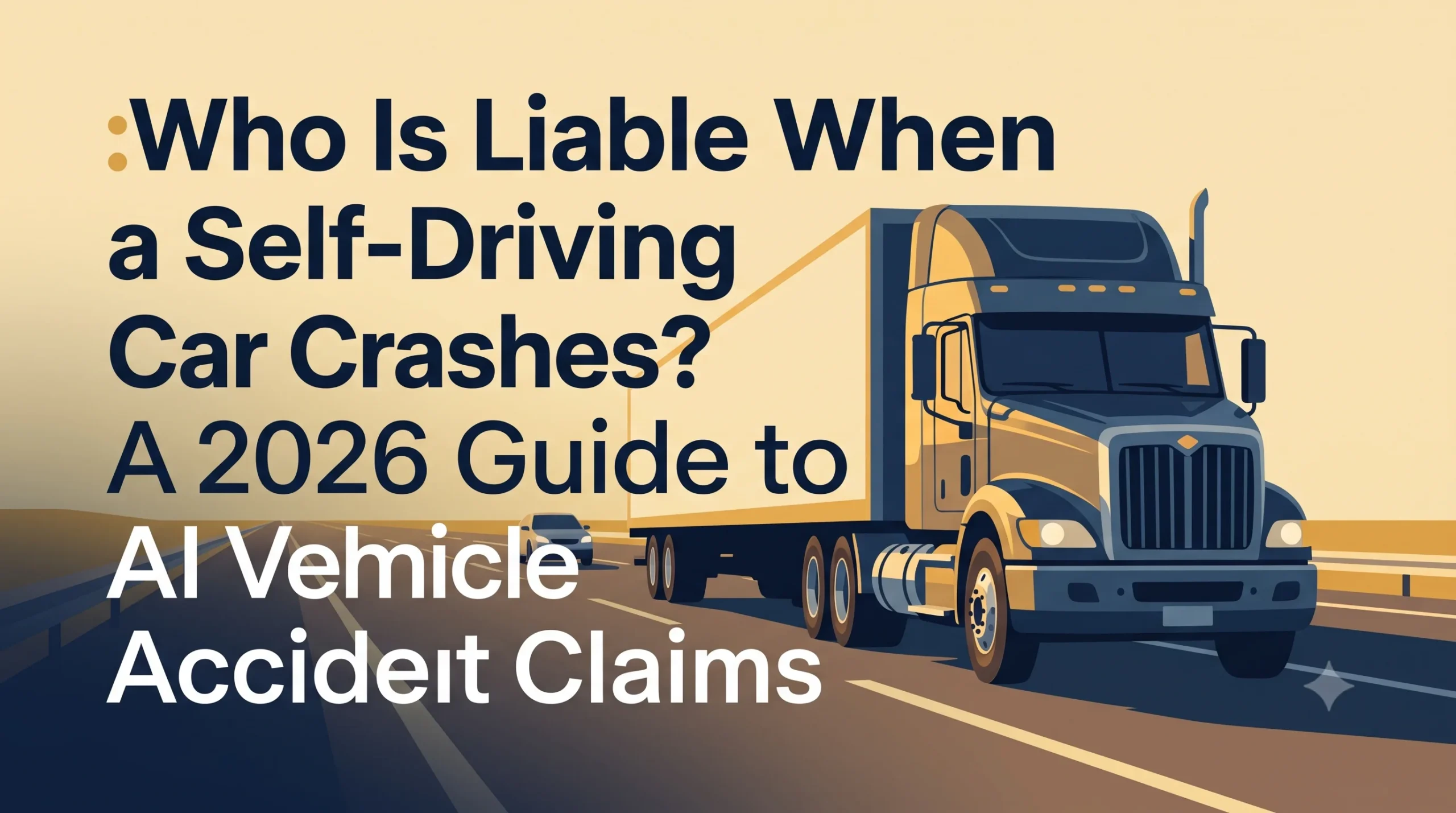
Have you ever watched a freight train try to stop? It takes a long time and a lot of distance, right? A fully loaded commercial truck operates on a very similar principle. When we talk about why semi-truck crashes are so devastating, we are ultimately talking about the undeniable laws of physics.
It comes down to two primary factors: size and weight.
An average passenger car weighs around 4,000 pounds. A fully loaded 18-wheeler? It can legally weigh up to 80,000 pounds. That is twenty times the weight of your car. If a standard sedan hits a concrete wall at 65 miles per hour, the damage is catastrophic. Now, imagine a vehicle twenty times that size, moving at the same speed, transferring all of its kinetic energy directly into the steel frame of your family car.
Your car simply isn’t designed to withstand that kind of blunt force trauma.
Because of this massive disparity in size and weight, the injuries sustained in commercial truck accidents are rarely minor. You aren’t just looking at a mild case of whiplash or a sprained wrist. Victims of these wrecks frequently suffer from life-altering conditions. We are talking about traumatic brain injuries (TBIs) that permanently alter cognitive function. We see spinal cord damage resulting in partial or total paralysis. There are often complex, multi-level bone fractures requiring multiple reconstructive surgeries, crush injuries, and severe internal organ damage.
These aren’t injuries you just “bounce back” from in a few weeks. They require emergency trauma care, extended stays in the intensive care unit, months or even years of intense physical therapy, and sometimes, lifelong, round-the-clock home care.
The financial cost of this level of medical intervention is staggering. A single helicopter flight from the crash scene to a Level 1 trauma center can cost tens of thousands of dollars. The lifetime cost of care for a severe brain or spinal cord injury can easily stretch into the millions.
This severity is the foundation of why an 18-wheeler accident claim commands a higher value. The compensation must reflect not just the immediate emergency room bill, but the profound, enduring impact on the victim’s physical health, emotional well-being, and capacity to earn a living for the rest of their life.
Why Claims Are Valued Higher: Follow the Money and the Liability
If you get rear-ended by your neighbor in a minivan, the legal path is usually straightforward. Your neighbor made a mistake, and their personal auto insurance pays for the damage up to their policy limit. That limit might be $50,000 or $100,000.
Truck accidents do not work this way. When a commercial truck causes a crash, a massive web of corporate liability and high-dollar insurance policies is instantly activated.
The Reality of Commercial Insurance Policies
The trucking industry is a highly lucrative, multi-billion-dollar machine. Because the federal government recognizes how dangerous these massive vehicles are, it mandates that commercial motor carriers carry significantly higher insurance minimums than everyday drivers.
While a regular driver might legally get away with carrying $25,000 in liability coverage, commercial trucks hauling general freight are federally required to carry at least $750,000 in liability insurance. If they are transporting hazardous materials—like gasoline, toxic chemicals, or industrial waste—that minimum legal requirement jumps to $1,000,000 or even $5,000,000 per incident.
Furthermore, many large, national logistics and freight companies don’t just carry the bare minimum. They carry large umbrella policies that can provide tens of millions of dollars in coverage to protect their corporate assets from catastrophic lawsuits.
Simply put: there is significantly more money available to compensate victims in a commercial truck accident settlement than in a standard auto collision.
The Web of Multiple Liable Parties
Here is where a truck accident lawyer earns their keep. In a standard car crash, there is usually one defendant: the other driver. In a commercial trucking case, the driver is often just the tip of the iceberg.
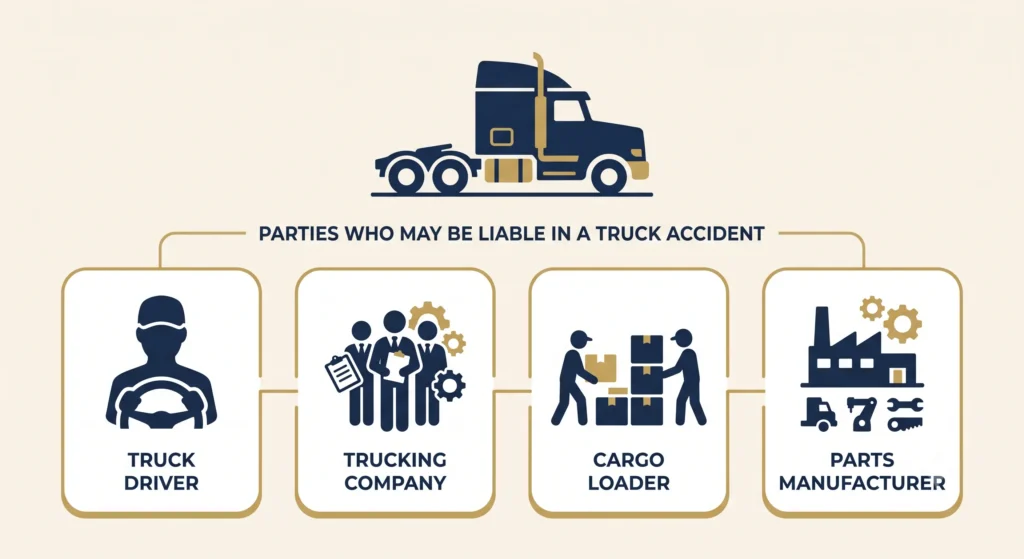
Because commercial trucking involves a complex supply chain, there are multiple parties who might share the legal blame—and therefore, the financial responsibility—for your injuries. Let’s look at the usual suspects:
- The Truck Driver: Was the driver texting, speeding, driving under the influence, or illegally driving beyond their federally mandated hours? If so, their negligence directly caused the crash.
- The Trucking Company (Motor Carrier): Employers are generally responsible for the actions of their employees while on the job. But beyond that, did the trucking company cut corners on safety? Did they force the driver to meet unrealistic, illegal delivery deadlines? Did they fail to run a proper background check and hire a driver with a history of DUIs or reckless driving? If the company’s culture prioritizes profit over public safety, they are heavily liable.
- The Maintenance Company: Many trucking fleets outsource their vehicle maintenance. If an independent mechanic signed off on bald tires or worn-out brake pads that subsequently failed on the highway, that mechanic’s business can be sued.
- The Cargo Loader or Shipper: Have you ever seen a truck tip over on a highway off-ramp? Often, this happens because the trailer was improperly loaded. If cargo is loaded unevenly, excessively heavy, or not properly secured, it can shift dramatically during transit, throwing the entire 18-wheeler off balance. In these cases, the third-party logistics company that loaded the trailer is liable.
- The Manufacturer: Sometimes, accidents happen not because of human error, but because of a mechanical defect. If a steering column snaps, a tire blows out due to a manufacturing flaw, or an air brake system fails, the multi-national corporation that manufactured those parts can be held responsible under product liability laws.
Identifying all these potential defendants is crucial. Why? Because you aren’t just filing a single claim against one insurance policy. You are potentially building a layered case against three or four massive corporate entities, each with their own multi-million dollar insurance policies. This exponentially increases the potential value of your recovery.
Federal Trucking Regulations That Can Strengthen a Claim
The trucking industry isn’t just regulated by standard state traffic laws. Because commercial trucks cross state lines and pose a unique danger to the public, they are heavily governed by the Federal Motor Carrier Safety Administration (FMCSA), a division of the U.S. Department of Transportation.
Understanding and leveraging these federal regulations is the key to unlocking the true value of an 18-wheeler accident claim. When a trucking company or a driver violates these rules, it establishes a powerful legal concept called “negligence per se.” This means you don’t just have to prove they were acting carelessly; you simply prove they broke a federal safety law, which heavily implies their liability.
The FMCSA Hours of Service (HOS) Rules
Driver fatigue is a silent killer on the highway. To combat this, the FMCSA strictly dictates how long a commercial driver can be behind the wheel without resting. These are known as the Hours of Service (HOS) regulations.
Under current rules, a property-carrying truck driver can generally only drive for a maximum of 11 hours after having 10 consecutive hours off duty. Furthermore, they cannot drive beyond the 14th consecutive hour after coming on duty, regardless of how many hours they actually spent driving within that window. They are also required to take mandatory 30-minute breaks.
Despite these clear laws, trucking companies routinely pressure drivers to break them. Dispatchers offer bonuses for early deliveries or threaten to fire drivers who are “too slow.” To meet these impossible demands, drivers sometimes falsify their logs and drive exhausted. An experienced attorney will subpoena these records to prove the driver was legally exhausted at the time of your crash.
Electronic Logging Devices (ELDs) and the “Black Box”
In the past, truck drivers kept paper logbooks to track their hours. These were notoriously easy to fake, often referred to in the industry as “comic books.”
Today, federal law mandates that most commercial trucks be equipped with an Electronic Logging Device (ELD). This system automatically records the truck’s engine hours, vehicle movement, and miles driven, making it much harder to lie about hours of service.
Even more importantly, modern 18-wheelers are equipped with an Engine Control Module (ECM) or Event Data Recorder (EDR)—commonly known as the “black box.” This is a goldmine of digital evidence. In the event of a crash, the black box records exactly what the truck was doing in the seconds leading up to the impact.
It records critical data such as:
- The exact speed of the truck.
- When and if the driver applied the brakes.
- The engine RPM.
- Whether cruise control was engaged.
- Steering inputs and sudden lane changes.
- Seatbelt usage.
If a truck driver claims they “slammed on the brakes” to avoid you, but the black box data shows the brakes were never applied until half a second before impact, their credibility is instantly destroyed. Securing this digital footprint before it is erased or overwritten is one of the most critical steps in building a high-value claim.
Common Causes of 18-Wheeler Crashes
While every accident is unique, commercial truck crashes typically follow distinct patterns of negligence. Recognizing these common causes helps in pinpointing exactly who is at fault.
- Driver Fatigue: As mentioned above, exhausted drivers have slower reaction times, impaired judgment, and can literally fall asleep at the wheel. A 40-ton missile driven by a sleeping man is a worst-case scenario.
- Distracted Driving: Truck drivers spend long, lonely hours on the road. The temptation to text, scroll through social media, watch videos on a mounted tablet, or talk on a hands-free device is incredibly high. Looking away from the road for just four seconds at 65 mph means driving the length of a football field entirely blind.
- Improper Loading and Cargo Shifts: If a flatbed is hauling massive steel coils and they aren’t chained down according to specific DOT regulations, they can break loose and crush surrounding vehicles. Inside enclosed trailers, unbalanced cargo can cause a rollover crash when the truck navigates a curve.
- Mechanical Failure and Poor Maintenance: Trucking companies have a legal duty to perform pre-trip, en-route, and post-trip inspections. Yet, to save money and time, they often skip these checks. Worn-out brakes on steep downhill grades, blown tires due to improper inflation, and burned-out headlights are completely preventable failures that cause fatal wrecks.
- Speeding to Meet Deadlines: Time is money in the logistics industry. Drivers are often paid by the mile, not by the hour. This creates a financial incentive to speed, ignoring the fact that a speeding 18-wheeler requires significantly more distance to stop than a passenger car.
- Driving Under the Influence: While less common than fatigue, the use of amphetamines or “trucker speed” to stay awake, or alcohol and prescription drugs, remains a serious issue that impairs driving ability.
What to Do in the First 48 Hours After the Accident
The actions you take—and the mistakes you avoid—in the first two days following a commercial truck crash can absolutely make or break your case. The trucking company’s insurance adjusters are already building a defense against you before you’ve even left the emergency room. Here is your survival guide for the first 48 hours.
- Prioritize Your Health Immediately: If you haven’t already, go to the hospital. Even if you think you just feel “sore,” adrenaline masks severe pain. Internal bleeding, hairline fractures, and traumatic brain injuries often don’t show symptoms for hours or days. Refusing medical treatment at the scene creates a gap in your medical records that the insurance company will aggressively use to argue you weren’t actually hurt by the crash.
- Do Not Give a Recorded Statement: This is critical. The trucking company’s insurance adjuster will likely call you within 24 hours. They will sound incredibly sympathetic. They will ask to record a quick statement “just to get the facts straight.” Do not do it. They are highly trained interrogators looking for you to say something—anything—that shifts the blame onto you. Politely decline and tell them they can speak to your lawyer.
- Preserve All Evidence: If you or a loved one are physically able, take photos of everything. Your car, the truck, the license plates, the DOT numbers painted on the side of the truck’s cab, skid marks on the road, road debris, and your visible injuries. Save all discharge paperwork from the hospital.
- Do Not Post on Social Media: Go completely dark on Facebook, Instagram, Twitter, and TikTok. The defense attorneys will comb through your profiles. If you post a photo of yourself smiling at a family barbecue three days after the crash, they will argue in front of a jury that your injuries are exaggerated.
- Hire a Truck Accident Lawyer Immediately: You cannot wait weeks to do this. Remember that “black box” we discussed? The trucking company legally owns that truck. They can repair it, wipe the digital data, and put it back on the road. A skilled attorney will immediately issue a “spoliation letter”—a legally binding demand requiring the trucking company to preserve the truck, the black box data, the driver’s logs, and all dispatch communications. If you wait too long, this vital evidence vanishes.
How Settlement Negotiations Differ from Car Accident Claims
You might assume that because your injuries are obvious and the truck driver was clearly at fault, the insurance company will just write you a fair check.
That is not how commercial trucking claims work.
In a standard car accident claim, negotiations are often relatively fast. It’s a simple dance between your lawyer and one adjuster.
A commercial truck accident settlement negotiation is akin to corporate warfare. Because the policy limits are in the millions, the insurance company will fight tooth and nail to protect their bottom line. They employ teams of aggressive defense attorneys, accident reconstruction experts, and private investigators to tear down your claim.
Here is how the battlefield differs:
- The Tactic of Blame Shifting: In a car crash, it’s usually driver A vs. driver B. In a truck crash with multiple corporate defendants, they will often try to point the finger at each other to delay your payout. The trucking company blames the independent mechanic; the mechanic blames the brake manufacturer; they all blame you for allegedly merging too closely. A strong attorney forces them to stop playing games and accept joint liability.
- The Use of High-Level Experts: To maximize your claim, your lawyer won’t just submit medical bills. They will hire their own accident reconstructionists to download the black box data and build 3D models proving the truck driver’s negligence. They will hire medical experts to testify about your future surgical needs, and vocational economists to calculate exactly how much future income you will lose because you can no longer work in your chosen profession.
- The Stalling Game: Commercial insurers know you are likely out of work and struggling to pay rent. They will intentionally drag out the litigation process, hoping you become so desperate for cash that you accept a lowball early settlement offer. Your attorney’s job is to shield you from this pressure, file the lawsuit, and push aggressively toward trial if the insurance company refuses to offer a fair value. Juries tend to dislike reckless trucking companies, and the genuine threat of a public trial is often what finally forces the insurer to write the large check you deserve.
FAQ Block
1. How much is an 18-wheeler accident claim actually worth? There is no magic formula or average settlement calculator. The final amount can vary significantly depending on the state, the case facts, the severity of your physical injuries, the amount of insurance coverage available, and your degree of fault (if any). Minor injury claims might settle for tens of thousands, while cases involving catastrophic injuries or wrongful death can result in substantial, life-changing awards.
2. Can I still recover money if I was partially at fault for the crash?
In most states, yes. Many jurisdictions follow a legal doctrine called “comparative negligence.” This means that even if you were 10% or 20% to blame for the accident (for example, you were speeding slightly), you can still recover compensation, though your total award will be reduced by your percentage of fault. Your attorney will fight to minimize any blame placed on you.
3. How long do I have to file a lawsuit?
Every state has a “statute of limitations,” which is a strict legal deadline for filing a personal injury lawsuit. It generally ranges from one to four years from the date of the accident, depending on where the crash occurred. If you miss this deadline, you permanently lose your right to sue, no matter how badly you were hurt.
4. The trucking company offered me a check right away. Should I take it?
Absolutely not. Early settlement offers are notoriously predatory. The insurance adjuster is trying to buy you off cheap before you realize the true long-term cost of your medical care and before you hire a lawyer who knows the claim’s actual value. Once you sign the release and take that check, you can never ask for more money later.
5. How much does a truck accident lawyer cost?
The vast majority of personal injury attorneys work on a “contingency fee” basis. This means you do not pay a single penny out of pocket, and there are no upfront hourly fees. The lawyer finances the entire case, and they only get paid a percentage of the final settlement or jury verdict if they win your case. If they lose, you owe them nothing for their services.
6. Will my case have to go to trial in a courtroom?
Most personal injury cases—even complex commercial trucking claims—are settled out of court through aggressive negotiation or formal mediation. Going to trial is expensive and risky for both sides. However, if the insurance company refuses to offer a fair settlement that covers all your damages, a skilled trial lawyer will absolutely take your case before a judge and jury to fight for what you deserve.
Disclaimer: The information provided in this article is intended for general educational and informational purposes only. It does not constitute legal advice, nor does it establish an attorney-client relationship. The laws regarding personal injury and commercial trucking vary by state and are subject to change. If you or a loved one have been involved in a collision, you should immediately consult with a licensed, experienced attorney in your local jurisdiction to discuss the specific facts of your case and protect your legal rights.