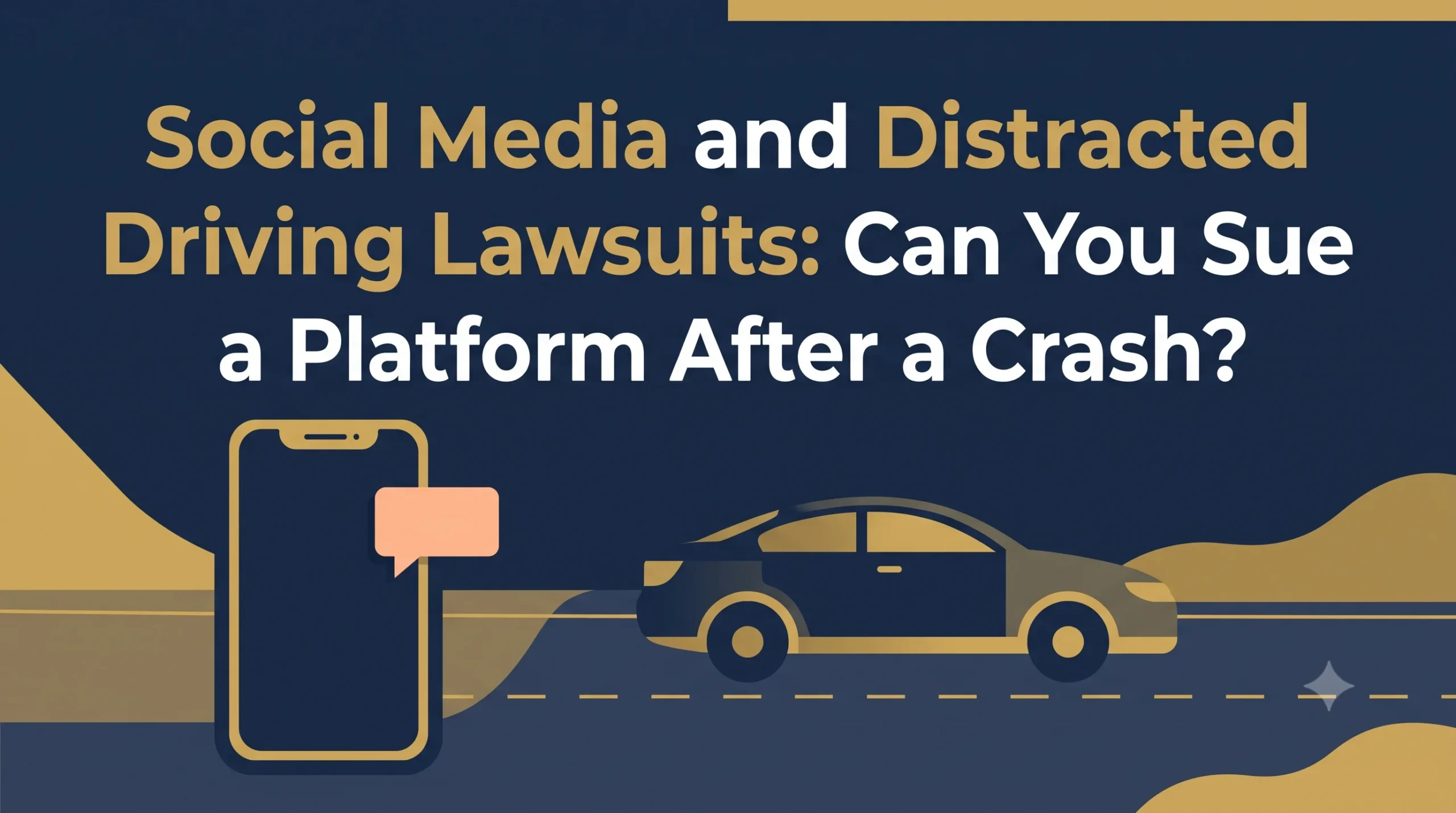
Social Media and Distracted Driving Lawsuits: Can You Sue a Platform After a Crash?
We all know the danger of looking at a phone while driving. For years, public safety campaigns, strict traffic laws, and heavy fines have tried to curb the impulse to text, scroll, or snap a photo from behind the wheel. Yet, collisions caused by inattentive motorists remain a persistent crisis on our roadways. Traditionally, the legal path after such an accident was straightforward: you held the careless driver and their insurance company responsible.
But as the digital landscape evolves, so do the legal questions surrounding these tragic incidents. A new, complex conversation is happening in courtrooms across the country. Plaintiffs are beginning to ask whether the companies that design our most popular digital applications share some of the blame when their products are used dangerously on the road. This isn’t just about someone deciding to pick up their phone; it is about examining the underlying architecture of the applications themselves.
Lawyers are exploring whether certain application features—like speed-tracking filters, auto-playing videos, or rewards for constant engagement—are intentionally designed to captivate users’ attention so aggressively that they encourage reckless behavior. These legal arguments are probing the boundaries of product liability, asking if software developers owe a duty to the public to prevent foreseeable harm. It is a fascinating, highly contested frontier in modern law.
If you are navigating the aftermath of a severe collision, understanding these developing theories can shed light on the broader context of digital-age litigation. Let us delve into why these novel legal arguments are emerging, the massive hurdles they face, and what it all means for the future of roadway safety.
How Distracted Driving Claims Traditionally Work
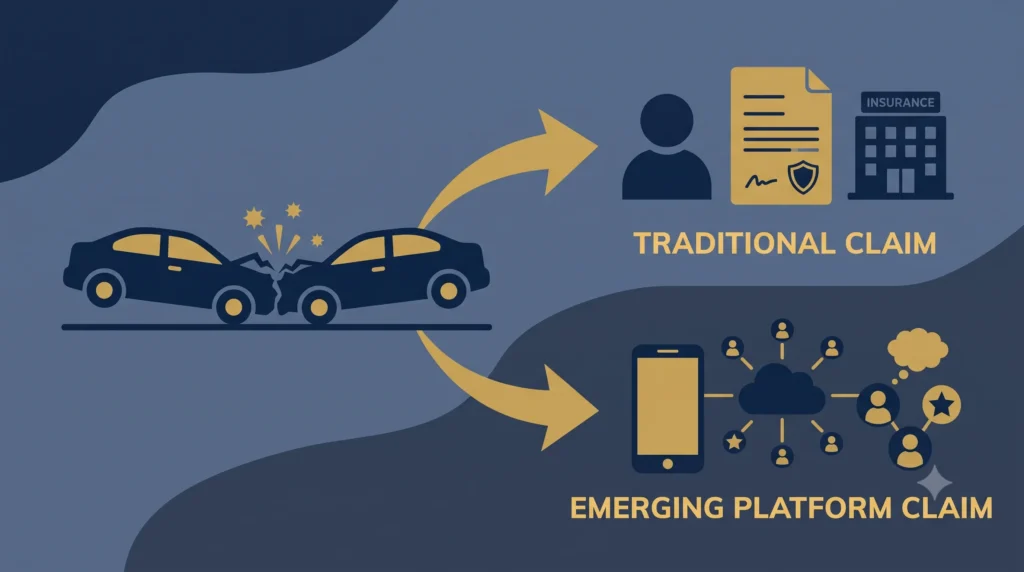
To understand why the legal landscape is shifting, it is helpful to first look at the traditional anatomy of a car accident claim. Historically, liability in a crash boils down to the concept of negligence. Negligence, in legal terms, means that someone failed to act with the level of care that a reasonable person would have exercised under the same circumstances.
When a driver gets behind the wheel, they assume a legal duty of care to everyone else on the road—pedestrians, cyclists, and other motorists. This duty requires them to obey traffic laws, maintain control of their vehicle, and, crucially, keep their eyes and attention on the road. If a driver breaches that duty by looking down at their phone to read a message or record a video, and that breach directly causes an accident resulting in damages, they are legally liable for the fallout.
In these conventional scenarios, the injured party—the plaintiff—typically files a claim against the at-fault driver’s auto insurance policy. The process revolves around proving the driver’s specific negligent acts. Investigators and attorneys will gather police reports, interview eyewitnesses, and perhaps look at the damage to the vehicles to demonstrate that the driver was inattentive. If the evidence clearly shows the driver was distracted, the insurance company will usually negotiate a settlement to cover medical bills, lost wages, vehicle repair costs, and pain and suffering.
If the insurance limits are insufficient to cover catastrophic injuries, or if the insurer refuses to offer a fair settlement, the victim might file a standard distracted driving lawsuit directly against the at-fault driver. The focus remains entirely on the individual’s choices and actions. The driver chose to look away; the driver caused the crash; the driver (or their insurer) pays. The manufacturer of the car isn’t usually blamed, nor is the maker of the smartphone, provided those physical products functioned as intended. For decades, this framework has been the undisputed standard for resolving motor vehicle accident claims.
The Emerging Legal Theory Behind Platform Liability Claims
The conversation begins to change when legal professionals look beyond the individual driver’s negligence and examine the digital environment that captured their attention. A novel legal theory is currently being tested in courts, proposing that the software platforms themselves might bear partial responsibility for accidents caused by their users.
This is not an argument that the platform forced the user to drive recklessly. Rather, it is a nuanced argument rooted in the principles of product liability. In the realm of physical goods, if a company manufactures a chainsaw without a safety guard and someone gets hurt, the company can be sued for a design defect. The emerging theory attempts to apply this same logic to intangible digital products—software applications and social media platforms.
The core argument is that certain features are not just neutral tools, but are deliberately engineered to be addictive and to promote risky behavior. For example, plaintiffs’ attorneys have scrutinized features that reward users for recording their physical speed, or algorithms that supply a never-ending stream of content designed to trigger a dopamine loop, making it psychologically difficult for the user to look away.
Under this theory of negligent design, attorneys argue that platform developers know, or reasonably should know, that their applications are being used by drivers. Despite this foreseeable risk, the argument goes, developers continue to implement gamification and engagement features that inherently distract users. Plaintiffs argue that if a developer can foresee that a feature will encourage dangerous real-world behavior—like speeding to unlock a digital reward—they have a duty to implement safeguards. This might look like a mechanism that disables certain features when the device is traveling at highway speeds, or a redesign of the algorithm to reduce compulsive checking.
It is vital to understand that this is an emerging, highly debated theory, not established law. A social media accident lawsuit testing these boundaries is essentially asking judges to expand traditional definitions of a “product” to include algorithmic design and software architecture. Tech companies vehemently push back, arguing that they provide a neutral service and cannot physically control how a consumer chooses to interact with their phone while driving.
The Legal Hurdles These Cases Face
While the theory of negligent design is compelling to some, suing a tech platform for a user’s driving behavior involves climbing a massive, incredibly steep legal mountain. These lawsuits face formidable defenses, chief among them being a federal statute known as Section 230 of the Communications Decency Act.
Enacted in the 1990s, Section 230 was designed to help the early internet grow. In plain language, it generally provides that operators of interactive computer services cannot be treated as the publisher or speaker of information provided by another user. This means if User A posts something defamatory or dangerous on Platform B, User A is liable, but Platform B is traditionally shielded from liability. Tech companies frequently use Section 230 as a robust shield against lawsuits, arguing that if a driver is distracted by content on their app, the app is merely hosting third-party content and cannot be held legally responsible for the consequences of a user consuming it.
When plaintiffs attempt to bypass Section 230, they usually try to argue that they are not suing over the content itself, but over the design of the product. They argue that a speed-tracking filter or a compulsive notification system is a product feature created by the company, not third-party content.
However, courts have often struggled with where to draw the line between a platform’s design and its role as a publisher. If a court decides that an algorithm recommending videos is simply a modern way of organizing third-party speech, Section 230 will likely block the lawsuit. If a court decides that a specific gamified feature exists independently of user content and actively encourages physical danger, the lawsuit might survive a motion to dismiss.
Beyond Section 230, plaintiffs also face the traditional hurdle of “proximate cause.” In law, you must prove that the defendant’s action directly caused the injury. Tech companies argue that the proximate cause of a crash is always the driver’s independent, illegal decision to look at their phone, not the app sitting on the device. Breaking the chain of causation to pin the blame on a developer thousands of miles away requires exceptionally persuasive legal reasoning.
How These Cases Differ from a Standard Car Accident Claim
The contrast between a standard collision claim and one involving platform liability is stark. A standard claim is typically a localized dispute. It involves local police, local drivers, local insurance adjusters, and well-worn paths of state traffic law. The timeline is relatively predictable, and the legal arguments are based on centuries-old concepts of basic negligence.
In contrast, introducing a tech platform as a defendant transforms a standard personal injury case into complex, high-stakes commercial litigation. Instead of just dealing with a driver’s auto insurance policy, plaintiffs are going up against multinational technology conglomerates backed by massive legal teams and nearly limitless resources.
The scope of discovery—the formal process of exchanging information between parties—is also entirely different. In a standard case, discovery might involve swapping medical records and vehicle repair estimates. In a platform liability case, plaintiffs’ attorneys are fighting for access to highly guarded corporate secrets. They want to see internal memos, algorithmic source code, beta testing results, and psychological research conducted by the developers to prove that the company knew its product was dangerously addictive or foreseeably harmful to motorists.
Furthermore, because this legal territory is so unmapped, these cases often take years to resolve. They frequently bounce between state and federal courts, generating complex appeals regarding statutory interpretation and constitutional rights, such as First Amendment protections for corporate speech. The financial cost, the time commitment, and the legal uncertainty in these hybrid product-liability-negligence cases are exponentially higher than in a traditional auto accident claim.
What Evidence Might Matter
If a plaintiff decides to pursue a complex claim involving a distracted driver and a digital platform, the evidentiary requirements become intensely technical. Proving that an app’s specific design contributed to a crash requires far more than just a police report stating the driver was holding a phone.
First, establishing the exact timeline of digital activity is critical. Investigators will rely heavily on forensic extraction of data from the at-fault driver’s smartphone. This goes beyond looking at call logs or text messages. Forensic experts must analyze app usage logs, background data consumption, and metadata to determine exactly which application was open, active, and engaging the user at the precise millisecond of the collision.
Second, the plaintiff must connect that specific app usage to the physical realities of the crash. This is where accident reconstruction experts become invaluable. These specialists use physics, vehicle telematics (like the car’s event data recorder or “black box”), and scene evidence (like the lack of skid marks indicating no braking occurred) to calculate exactly how long the driver was inattentive. By overlapping the digital forensic timeline with the physical reconstruction timeline, attorneys attempt to paint a definitive picture of the distraction.
Finally, to pursue the platform itself, plaintiffs need evidence of corporate knowledge and intent. As mentioned earlier, this involves unearthing internal communications. Did the developers conduct studies showing that a specific feature was frequently used by people traveling at high speeds? Did they receive complaints about the feature’s danger and choose to ignore them in favor of increased user engagement? Finding a “smoking gun” internal email or design document is often considered the holy grail in these types of complex product liability arguments.
Practical Steps If You Were Hit by a Distracted Driver
While the high-level legal theories regarding app developers are fascinating, the immediate reality of being hit by a distracted driver requires grounded, practical action. If you find yourself in this unfortunate situation, prioritizing your health and preserving evidence are your paramount concerns.
- Seek Immediate Medical Attention: Your physical well-being is the top priority. Even if you feel fine immediately after the crash, adrenaline can mask severe injuries like whiplash, concussions, or internal bleeding. See a doctor right away, as creating a medical record immediately following the accident is crucial for any future claims.
- Call Law Enforcement: Always have the police respond to the scene. A police report provides an objective, third-party assessment of the crash. Tell the responding officer if you suspect the other driver was using their phone. They may look for signs of distraction or note the driver’s statements in the official report.
- Document the Scene: If you are physically able, take extensive photographs of everything. Capture the damage to all vehicles, the resting positions of the cars, license plates, skid marks (or the absence of them), traffic signs, and weather conditions.
- Gather Witness Information: Independent witnesses are vital. If anyone saw the crash, or specifically saw the other driver looking down or holding a glowing screen before the impact, get their names and contact information immediately. People leave the scene quickly, and their memories fade fast.
- Do Not Discuss the Crash on Social Media: It is a harsh irony, but posting about your accident on your own digital platforms can harm your case. Insurance adjusters will look for your profiles to find evidence that contradicts your injury claims. Keep the details of your accident offline.
- Seek Professional Legal Guidance: Because proving digital distraction can involve complex forensic work, relying on an experienced advocate is highly recommended. Consulting a texting and driving lawyer can help you understand your immediate rights against the driver and their insurance, and they can determine if the specific facts of your case warrant a deeper investigation into broader liability.
Frequently Asked Questions (FAQ)
1. Is it currently a recognized law that I can sue a social media company if a distracted driver hits me?
No. It is not an established, universally recognized law. It is an emerging and highly experimental legal theory. While a few specific cases have survived early motions to dismiss, courts generally lean toward protecting platforms under existing laws like Section 230. Most of these lawsuits are dismissed before they ever reach a jury.
2. What is the difference between suing the driver and suing the platform?
Suing the driver is based on standard negligence—they breached their duty to drive safely. Suing the platform is based on product liability or negligent design—arguing that the company created an unreasonably dangerous product that encouraged the driver’s bad behavior. Suing the driver is standard practice; suing the platform is exceptionally difficult.
3. Does Section 230 protect apps from everything?
Section 230 offers broad immunity regarding third-party content. If a driver is distracted by a video someone else posted, the app is generally protected. However, plaintiffs are testing whether Section 230 protects the architectural design of the app itself, such as features that track speed or algorithms designed to be addictive, arguing these are product defects rather than hosted content.
4. How do police or lawyers prove the other driver was on an app?
Proving app usage requires deep investigation. It may start with witness testimony or the driver’s own admission. From there, lawyers can subpoena cell phone records and, more importantly, hire digital forensics experts to extract highly detailed usage logs directly from the smartphone’s hardware to see exactly what was happening on the screen at the time of impact.
5. Can my own app usage be used against me if I was hit by someone else?
Yes. In many states, the concept of comparative negligence applies. If the defense can prove that you were also distracted by your phone or a digital platform at the time of the crash, your potential financial recovery could be significantly reduced, or in some states, barred entirely.
6. Should I wait to see if the law changes before filing a claim?
No. Every state has a strict statute of limitations, which is a hard deadline for filing a personal injury lawsuit. If you wait for complex legal theories to be resolved in the higher courts, you will likely miss your window to sue the clearly negligent driver who hit you. Always act promptly to secure your immediate legal rights.
Disclaimer: This article provides a general educational overview of an evolving area of law and does not constitute legal advice. The legal theories regarding platform and product liability in distracted driving cases are highly unsettled, and court outcomes vary wildly depending on jurisdiction and specific case facts. If you have been involved in an accident, laws and deadlines apply strictly to your situation. You should always consult with a licensed, qualified personal injury attorney in your state to discuss the specific details of your case.