Camp Lejeune Water Contamination Claims: A Complete 2026 Eligibility and Filing Guide
For decades, the men and women who served at Marine Corps Base Camp Lejeune in North Carolina, alongside their families and the civilian staff who supported them, were exposed to severely contaminated drinking water. Between the early 1950s and the late 1980s, an invisible hazard flowed through the base’s water supply, carrying volatile organic compounds and toxic chemicals into the homes, barracks, and workplaces of military communities. Decades later, the physical and emotional toll of that exposure remains a heavy burden for thousands of veterans and military families.
The passage of the Camp Lejeune Justice Act (CLJA) as part of the broader PACT Act finally opened a legal pathway for those affected to seek justice and compensation. Now, as we move through 2026, the initial waves of administrative filings have transitioned into a complex landscape of document reviews, government elective options, and active federal litigation. Understanding how this legal mechanism works is critical for families who are still trying to navigate their claims. This comprehensive guide outlines the factual background of the contamination, details who is generally eligible for a Camp Lejeune claim, explains the health conditions linked to the toxic water, and demystifies the ongoing legal and administrative processes.
Our commitment to honoring the military community demands honesty, clarity, and respect. This guide is written to provide straightforward, actionable information without sensationalism or false promises, recognizing the sacrifices made by those who lived and served at Camp Lejeune.
About the Author’s Expertise:
This guide is authored by a veteran-focused legal content specialist with extensive experience translating complex mass tort litigation and military law into accessible, practical information. Dedicated to the unique legal challenges faced by service members, veterans, and their families, the author has closely tracked the legislative journey and subsequent federal litigation surrounding the Camp Lejeune Justice Act. We believe that veterans deserve transparent, high-quality legal information rooted in verifiable facts and legal precedent, empowering them to make informed decisions about their health and their legal rights.
The History and Reality of the Camp Lejeune Contamination
To understand the current legal landscape, it is essential to look at the plain facts of what occurred at Camp Lejeune. The water contamination at the base is considered one of the worst public health disasters in United States history.
From August 1, 1953, to December 31, 1987, the tap water provided to residents and workers at Camp Lejeune was contaminated with hazardous chemicals at levels far exceeding what is considered safe. The contamination primarily affected two of the eight water treatment plants on the base: the Tarawa Terrace water treatment plant and the Hadnot Point water treatment plant.
At Tarawa Terrace, the primary contaminant was perchloroethylene (PCE), a volatile organic compound heavily used in dry cleaning. Investigations later revealed that the source of the PCE was an off-base dry cleaning business that had been improperly disposing of its waste, which subsequently seeped into the groundwater supplying the base. At the Hadnot Point facility, the water was heavily contaminated with trichloroethylene (TCE), along with substantial levels of PCE, benzene, and vinyl chloride. The Hadnot Point contamination was largely attributed to on-base sources, including leaking underground storage tanks, industrial area spills, and waste disposal sites.
For over thirty years, Marines, sailors, their spouses, their children, and civilian employees drank, cooked with, and bathed in this water. The military did not officially shut down the most highly contaminated wells until the mid-1980s. For decades following the discovery of the toxic water, affected individuals struggled to hold the government accountable due to strict legal doctrines that historically barred service members from suing the military for injuries sustained during their service. The Camp Lejeune Justice Act removed that specific barrier, allowing those affected a historic, if delayed, opportunity to pursue legal recourse.
Who Is Generally Eligible for a Camp Lejeune Claim?
Determining Camp Lejeune claim eligibility relies on a combination of geographic location, time spent on the base, and specific dates of exposure. Unlike many military benefits that apply strictly to the service member, the Camp Lejeune Justice Act was intentionally written to cover a much broader scope of people, acknowledging that the military family and civilian support staff were equally exposed to the hazard.
Eligible Groups
- Military Veterans: Marines, sailors, and members of other armed forces branches who were stationed at, or deployed to, Camp Lejeune during the qualifying period.
- Military Family Members: Spouses, children, and dependents who lived in base housing or were otherwise present on the base. This crucially includes individuals who were exposed in utero (whose mothers were pregnant while living or working at Camp Lejeune).
- Civilian Contractors and Employees: Non-military personnel who worked on the base, including civil service employees, construction workers, and independent contractors.
Time and Duration Requirements
To meet the general threshold for eligibility under the law, an individual must have been exposed to the water at Camp Lejeune for a cumulative total of at least 30 days between August 1, 1953, and December 31, 1987.
The 30-day requirement does not need to be consecutive. For example, a civilian contractor who worked on the base for two weeks in 1975 and three weeks in 1976 would meet the 30-day minimum. Similarly, a reservist who spent several short training weekends at the base that add up to a month over the span of a few years would also generally qualify.
Note: The exact interpretation of dates, locations within the base boundaries, and qualifying criteria can be highly specific. Readers should always confirm their exact eligibility status, dates, and documentation with a licensed Camp Lejeune lawyer or an official government resource to ensure their specific situation meets the legal standards.
Health Conditions Associated with Camp Lejeune Water Exposure
The chemicals found in the Camp Lejeune water supply—specifically TCE, PCE, benzene, and vinyl chloride—are known human carcinogens and toxic agents. Over the years, extensive public health studies, including those conducted by the Agency for Toxic Substances and Disease Registry (ATSDR), have linked these specific chemicals to a variety of severe and chronic health conditions.
In the context of the ongoing litigation and the government’s settlement frameworks (such as the Elective Option introduced by the Department of Justice and the Department of the Navy), certain conditions are widely recognized as having strong presumptive links to the toxic water.
Tier 1 and Presumptive Conditions
These are illnesses for which health organizations and the government have established the most significant evidentiary links to the specific chemicals found at Tarawa Terrace and Hadnot Point. They frequently include:
- Kidney Cancer
- Liver Cancer
- Non-Hodgkin’s Lymphoma
- Leukemias
- Bladder Cancer
- Parkinson’s Disease
Tier 2 and Additional Conditions
Other severe health conditions have also been associated with the toxic exposure, though the legal and scientific arguments may require different levels of medical documentation depending on the individual’s history. These often include:
- Multiple Myeloma
- End-Stage Renal Disease (Kidney Disease)
- Systemic Sclerosis/Scleroderma
- Breast Cancer
- Prostate Cancer
- Certain neurobehavioral effects and reproductive issues (including severe birth defects or miscarriages for women exposed during the qualifying period).
It is important to approach these health lists cautiously. Not everyone who was exposed to the water will develop these conditions, and developing one of these conditions does not automatically guarantee a specific legal outcome. Furthermore, conditions not explicitly listed in the government’s fast-track settlement tiers may still be eligible for compensation through the standard litigation process, provided your medical and legal team can demonstrate causation. If you were at Camp Lejeune during the qualifying years and are experiencing unusual or chronic health issues, a thorough medical evaluation is highly recommended.
Navigating the Camp Lejeune Legal Process in 2026
As of 2026, the landscape of a Camp Lejeune lawsuit has evolved. The initial rush of filing administrative claims has largely concluded, as the statutory deadline to file new claims under the original two-year window of the CLJA closed in August 2024. Today, the focus for hundreds of thousands of veterans and families is on the complex, document-heavy phase of resolving those claims.
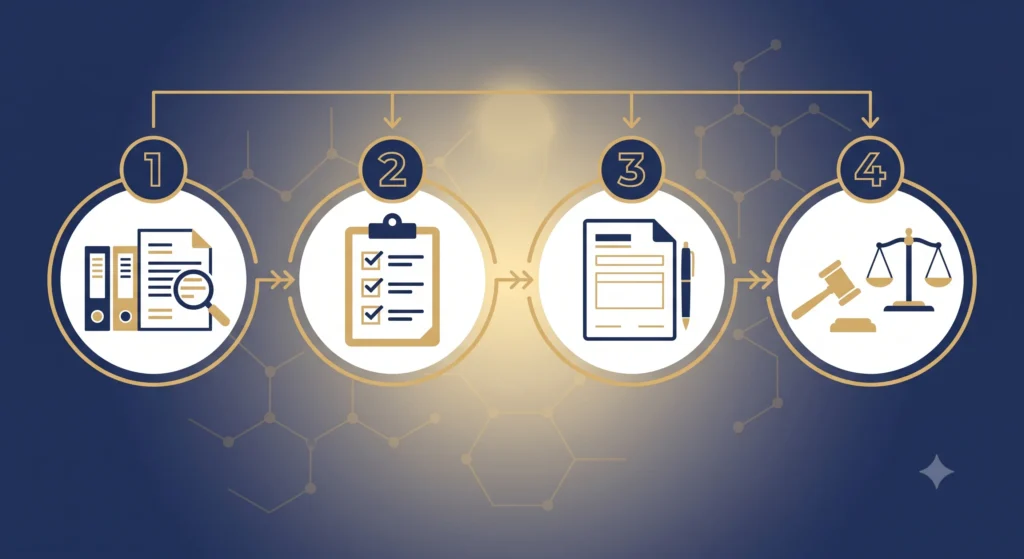
Phase 1: The Administrative Claim and Government Review
Under the law, claimants were required to file an administrative claim with the Department of the Navy before a federal lawsuit could be initiated. The government was given six months to review these claims. If the claim was denied, or if the six months passed without a decision, the claimant gained the right to file a formal lawsuit in the United States District Court for the Eastern District of North Carolina.
In 2026, the government is actively processing these claims. One of the primary mechanisms for resolution is the “Elective Option,” a voluntary settlement framework designed to fast-track payouts for claimants with specific, well-documented Tier 1 or Tier 2 health conditions. If a claim fits the rigid criteria of the Elective Option, the claimant may receive a settlement offer without needing to go to trial.
Phase 2: Litigation and Federal Court
If a claim does not fit the Elective Option, if the settlement offer is deemed inadequate, or if the government denies the claim, the case proceeds to the federal litigation track. By 2026, thousands of cases are actively pending in the Eastern District of North Carolina.
The court process is currently heavily focused on “expert discovery”—meaning both the plaintiffs and the government are presenting expert scientific, medical, and environmental testimony to establish the links between the water and the specific illnesses. The litigation is slow and highly detailed. The court categorizes cases into different tracks based on the type of disease, pushing representative “bellwether” cases forward to test the legal arguments and help establish baseline settlement values for the rest of the docket.
The Critical Role of Documentation
The most significant bottleneck in the entire process—and the primary reason many claims face delays in 2026—is documentation. To successfully navigate either a settlement or a trial, claimants must provide irrefutable proof of two things:
- Presence: You must prove you were at Camp Lejeune for at least 30 days during the qualifying period. For veterans, this usually means a DD-214, muster rolls, or military orders. For family members, it means housing records, military base school records, or marriage/birth certificates tying them to the service member stationed there. For civilians, tax records or employment contracts are necessary.
- Diagnosis: You must have certified medical records confirming the diagnosis of a qualifying illness. A simple doctor’s note is rarely sufficient; the government and the courts require comprehensive medical histories, pathology reports, and treatment records.
Gathering these documents decades after the fact can be deeply frustrating. A competent Camp Lejeune lawyer spends a massive amount of their time hunting down archived military records and decades-old medical files to solidify their clients’ claims.
What Compensation Categories Are Considered?
When evaluating a Camp Lejeune claim, the courts and the government look at various categories of damages to determine fair compensation. Because every individual’s bodily response, medical journey, and life circumstances are unique, there is no single, flat-rate payout that applies to everyone who files a lawsuit.
Generally, compensation is evaluated across several broad categories:
- Past and Future Medical Expenses: This includes the cost of hospital stays, surgeries, chemotherapy, specialized medications, in-home care, and medical travel directly related to the illness caused by the contamination.
- Lost Wages and Earning Capacity: If the illness forced the individual into early retirement, caused them to miss significant time at work, or permanently disabled them from earning a living, compensation may factor in these lost earnings.
- Pain and Suffering: This category addresses the physical pain and emotional distress endured due to the disease. The severe, chronic nature of cancers and neurological conditions heavily impacts this calculation.
- Wrongful Death: For families filing on behalf of a loved one who passed away from a contamination-linked illness, compensation may cover funeral expenses, loss of companionship, and the emotional toll on the surviving family.
It is crucial to understand that no specific dollar amounts can be guaranteed in any legal proceeding. While government fast-track options have set frameworks based on the type of disease and the length of time spent on the base, cases that proceed to a federal Camp Lejeune lawsuit will be evaluated strictly on the individual merits, documentation, and specific damages proven in court.
The Role of the VA Versus a Camp Lejeune Lawsuit
A common point of confusion for veterans is how a legal claim under the Camp Lejeune Justice Act interacts with the benefits they may already receive, or are applying for, through the Department of Veterans Affairs (VA).
VA Healthcare and Disability Benefits
Long before the CLJA was passed, the VA recognized certain presumptive conditions related to Camp Lejeune. Eligible veterans (and in some cases, family members) have been able to apply for VA health care and disability compensation for illnesses like adult leukemia, aplastic anemia, kidney cancer, liver cancer, multiple myeloma, non-Hodgkin’s lymphoma, and Parkinson’s disease.
Filing a lawsuit does not stop you from receiving VA benefits. You can, and should, continue to utilize VA healthcare and receive your monthly disability compensation for your service-connected conditions.
The “Offset” Rule
The Camp Lejeune Justice Act contains a specific provision designed to prevent “double dipping”—meaning the government will not pay you twice for the exact same medical bills or specific economic loss. If you win a settlement or a court award through your CLJA lawsuit, the final payout may be offset (reduced) by the amount of certain benefits you have already received from the VA, Medicare, or Medicaid for that specific illness.
However, this does not mean your VA benefits will be cut off moving forward, nor does it mean your lawsuit is worthless if you have a VA rating. The legal offset applies to the final judgment amount. Because civil litigation often accounts for “pain and suffering” and broader damages that the VA disability rating system does not cover, many veterans pursue both avenues. The interaction between VA benefits and a civil judgment is highly complex, making it imperative to seek guidance from a qualified Camp Lejeune lawyer who understands military offsets and mass torts.
Frequently Asked Questions (2026 Updates)
1. Is it too late to file a Camp Lejeune claim in 2026?
The initial administrative filing deadline under the Camp Lejeune Justice Act expired in August 2024. Therefore, filing a brand new claim if you took no prior action is generally barred by the statute of limitations. However, if you or your attorney filed the required administrative claim with the Navy before the deadline, your case remains active. The legal process in 2026 revolves around negotiating, documenting, and litigating those timely filed claims. Always consult an attorney regarding your specific timeline, as legal nuances occasionally apply to specific state laws or unique filing circumstances.
2. I submitted my claim, but I haven’t heard anything. Is this normal?
Unfortunately, yes. Over 400,000 administrative claims were filed with the Department of the Navy. As of 2026, the government is still working through massive backlogs. Claims that are fully documented with certified medical and service records are generally moving faster and receiving Elective Option settlement offers. If your claim lacks necessary documentation, it is likely sitting in a delayed status.
3. Do I have to accept the government’s Elective Option settlement?
No. The Elective Option is entirely voluntary. It is designed to offer a faster, guaranteed payout without the risk and wait of a trial. However, the amounts are predetermined based on a grid (factoring in the disease and time on base). If your medical expenses, lost wages, and suffering far exceed the grid’s offer, you and your attorney may choose to decline the offer and proceed with a formal federal lawsuit to seek higher compensation.
4. Can family members still pursue a lawsuit if the veteran has passed away?
Yes. If the veteran or family member who was exposed to the water has passed away, their legal representative or surviving family members can pursue a wrongful death claim or continue a claim that was already filed. You will need the deceased’s medical records, proof of their time at Camp Lejeune, and an official death certificate, alongside the proper legal authority to act on behalf of their estate.
5. I was dishonorably discharged. Am I still eligible?
Under the strict text of the Camp Lejeune Justice Act, individuals who received a dishonorable discharge are generally excluded from filing a claim. However, other types of discharges (Honorable, General Under Honorable Conditions, Other Than Honorable) usually do not bar you from seeking compensation. If your discharge status is complicated, you should discuss it confidentially with legal counsel.
6. Will my lawyer take money upfront to handle my Camp Lejeune lawsuit?
Reputable attorneys handling Camp Lejeune claims work on a contingency fee basis. This means they do not charge you any upfront out-of-pocket fees or hourly rates. Instead, they take a set percentage of the final settlement or court award if—and only if—they successfully recover money for you. If you do not win compensation, you do not owe attorney fees.
Disclaimer: The information provided in this 2026 guide is intended for general informational and educational purposes only and does not constitute legal or medical advice. The laws surrounding mass torts and military claims are complex and subject to change based on federal court rulings. Readers should not act upon any information in this article without first seeking professional counsel. We strongly recommend that you verify exact Camp Lejeune claim eligibility dates, current deadlines, and specific legal options with a licensed attorney or through official U.S. government resources, such as the Department of Justice or the Department of Veterans Affairs.