PFAS “Forever Chemicals” Lawsuits Explained: Are You Eligible to File a Contamination Claim?
In recent years, you may have seen a growing number of headlines, news reports, and community discussions surrounding PFAS. Often referred to by their colloquial name, “forever chemicals,” these substances have become a focal point of environmental regulatory action, public health research, and complex legal proceedings across the country. For many individuals, discovering that their local drinking water, workplace, or household products may contain these chemicals can understandably trigger feelings of anxiety and uncertainty regarding their family’s well-being.
If you are concerned about your own potential exposure or have been recently diagnosed with a serious medical condition and are searching for answers, you are not alone. Thousands of people, alongside municipal water districts and local governments, have begun seeking accountability from the chemical manufacturers that originally developed and distributed these substances.
The purpose of this comprehensive guide is to provide you with clear, objective, and well-researched information. We will explore the science behind these chemicals, the primary ways people come into contact with them, the health conditions currently being studied in relation to long-term exposure, and the legal mechanisms that affected individuals and communities are utilizing to seek restitution.
What Are PFAS and Why Are They Called “Forever Chemicals”?
PFAS is an acronym that stands for perfluoroalkyl and polyfluoroalkyl substances. This refers to a vast, complex group of synthetic chemicals that have been manufactured and used in a variety of industries worldwide since the 1940s. The most extensively produced and studied of these chemicals are PFOA (perfluorooctanoic acid) and PFOS (perfluorooctane sulfonic acid), though there are thousands of other variations currently in existence.
To understand why they are uniquely persistent, it helps to look at their basic chemical structure. PFAS molecules are constructed using chains of carbon and fluorine atoms. The carbon-fluorine bond is one of the strongest molecular bonds known in organic chemistry. Because this bond is so incredibly stable, these chemicals possess unique properties: they can effectively repel water, resist high temperatures, and block oil and grease.
Unfortunately, the exact chemical strength that makes PFAS so useful in manufacturing also makes them an environmental and biological hazard. Because the carbon-fluorine bond does not easily break down under natural conditions—whether exposed to sunlight, bacteria, or extreme weather—these substances do not degrade in the environment. When they are released into the air, soil, or water, they simply remain there, accumulating over time.
Furthermore, when humans and animals ingest or inhale these chemicals, the body struggles to process and excrete them. Over months and years, repeated exposure can lead to bioaccumulation, meaning the concentration of the chemicals in the blood and organs steadily increases. This extraordinary persistence in both the natural environment and the human body is exactly why scientists and environmental advocates appropriately dubbed them “forever chemicals.”
Common Sources of Exposure
Understanding how you might have come into contact with these substances is a critical first step in evaluating your personal risk profile. Because these chemicals have been utilized in such a wide array of consumer and industrial applications over the past eight decades, trace amounts can be found almost everywhere on Earth. However, there is a significant difference between trace, background exposure and the kind of heavy, long-term exposure that typically leads to a legal claim.
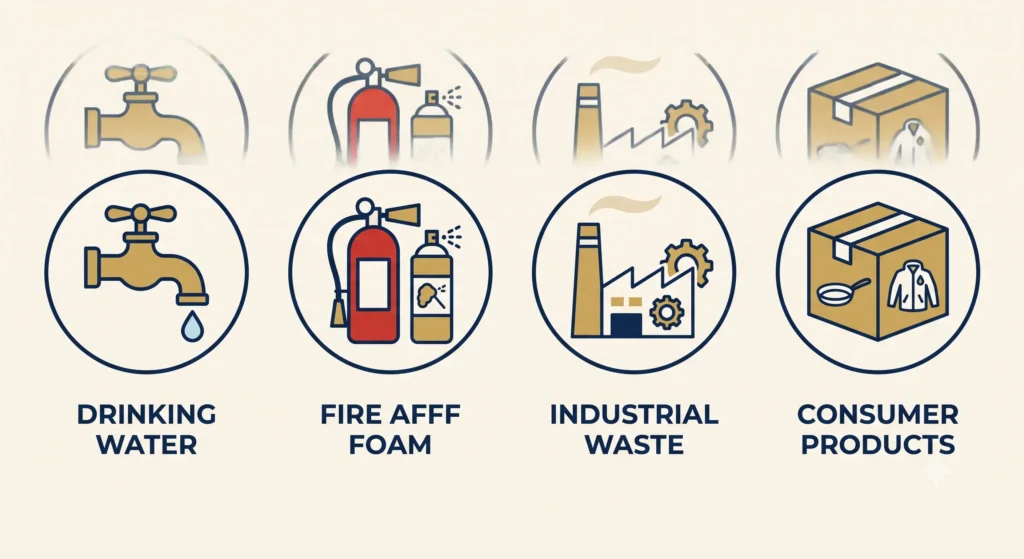
The most common pathways for significant exposure include the following:
Contaminated Drinking Water
For the general public, drinking water is one of the most prominent sources of exposure. Over the years, chemical manufacturing plants, industrial facilities, and military bases have discharged PFAS-laden wastewater into surrounding lakes, rivers, and soil. As the chemicals seep downward, they infiltrate the groundwater aquifers that supply municipal drinking water systems and private residential wells.
Because these chemicals are tasteless, colorless, and odorless, individuals can unknowingly consume contaminated water for decades. The United States Environmental Protection Agency (EPA) has recently taken unprecedented regulatory action to address this crisis. In April 2024, the EPA established the first-ever legally enforceable national drinking water standard, setting maximum contaminant levels for PFOA and PFOS at just 4 parts per trillion (ppt). This incredibly low threshold reflects the potency of these chemicals and the urgency of removing them from public utilities.
Aqueous Film-Forming Foam (AFFF)
A major occupational source of exposure involves a specific type of fire suppressant known as Aqueous Film-Forming Foam (AFFF). For decades, this specialized foam was heavily utilized by civilian firefighters, military personnel, and airport emergency crews to extinguish highly volatile, liquid-based fires (such as jet fuel or petroleum blazes).
AFFF contains incredibly high concentrations of PFAS. Service members and firefighters who routinely used this foam during training exercises or emergency responses often experienced direct dermal (skin) contact and inhalation. Furthermore, after the foam was sprayed, the residual chemicals were frequently hosed off runways or training grounds directly into the soil, leading to severe localized groundwater contamination near military bases and commercial airports.
Consumer Products and Household Goods
Because PFAS are exceptionally good at repelling oil, grease, and water, they have been historically incorporated into a vast array of everyday consumer products. Historically, they were a key component in the manufacturing of non-stick cookware (such as Teflon-coated pans), stain-resistant carpets, water-repellent outdoor clothing, cosmetics, and even grease-resistant food packaging (like microwave popcorn bags and fast-food wrappers).
While exposure through these products is generally considered to be at a lower concentration than occupational AFFF use or heavily contaminated drinking water, prolonged daily use over a lifetime still contributes to the overall bodily burden of these chemicals.
Industrial Sites and Manufacturing Facilities
Individuals who live in communities immediately surrounding manufacturing plants that produce or heavily utilize PFAS face a compounded risk. These facilities may emit the chemicals through smokestacks, where they are carried by the wind and deposited onto surrounding neighborhoods. Additionally, improper disposal of industrial waste in local landfills can cause chemical leachate to migrate into the local ecosystem, impacting nearby residential properties and agricultural lands.
Documented Health Concerns Associated with Long-Term Exposure
When dealing with complex chemical exposures, it is important to approach health information carefully and objectively. Toxicology and epidemiology are rigorous scientific fields, and establishing a direct, undeniable link between a specific chemical and a specific individual’s illness is medically and legally complex.
However, over the last two decades, significant scientific research—including large-scale epidemiological studies like the C8 Science Panel, which analyzed thousands of individuals exposed to contaminated water in the Ohio River Valley—has generated substantial data. Researchers and major public health organizations have studied potential links between elevated levels of PFAS in the blood and an increased risk of developing certain serious medical conditions.
It is crucial to note that the presence of a medical condition does not automatically prove it was caused by chemical exposure, as many of these illnesses have multiple risk factors, including genetics and lifestyle. Still, scientific literature suggests that prolonged, high-level exposure may be associated with the following health concerns:
- Specific Types of Cancers: Medical researchers have heavily scrutinized the relationship between these chemicals and cellular mutations. Studies have shown potential associations between long-term exposure and an elevated risk of developing kidney cancer and testicular cancer. Some emerging studies are also evaluating potential links to prostate cancer, liver cancer, and thyroid cancer.
- Thyroid Disease: The thyroid is a vital gland responsible for regulating the body’s metabolism. Research indicates that these chemicals may disrupt the endocrine system, potentially leading to thyroid disease, including both hypothyroidism and hyperthyroidism.
- Liver Damage: The liver is the body’s primary filtration organ, making it highly susceptible to chemical bioaccumulation. Studies have noted potential links between elevated exposure and liver damage, including changes in liver enzymes that can indicate cellular stress or disease.
- Immune System Suppression: Public health agencies, including the EPA, have noted that high levels of certain forever chemicals may be associated with a reduced immune system response. In practical terms, researchers have observed a potential decrease in vaccine response in both children and adults who have high concentrations of these substances in their bloodstream.
- Ulcerative Colitis: There is data suggesting a potential link between long-term exposure and an increased risk of developing ulcerative colitis, a chronic inflammatory bowel disease that causes inflammation and ulcers in the digestive tract.
If you have a history of significant exposure—such as serving as a military firefighter, living adjacent to a chemical manufacturing plant, or receiving notices of severe drinking water contamination—and you have developed any of these serious conditions, it is highly recommended that you consult closely with your physician. A medical professional can help you monitor your health, manage your symptoms, and discuss any potential lifestyle adjustments.
Who Is Generally Considered Eligible to Explore a Claim?
Determining whether you have the legal standing to pursue a civil claim against chemical manufacturers requires a careful analysis of your specific circumstances. Because the legal landscape is constantly evolving, there is no single, universal checklist that applies to every situation. However, in the context of personal injury and environmental litigation, there are several foundational criteria that legal professionals generally look for when evaluating a potential case.
To be eligible to explore a forever chemicals contamination claim, an individual typically needs to demonstrate two main elements: a verifiable history of significant exposure and a subsequent diagnosis of a related, qualifying medical condition.
1. Verifiable History of Significant Exposure
Trace exposure is, unfortunately, a reality for most of the modern population. Therefore, to build a viable legal claim, you generally must show that your exposure was significant, prolonged, and above average. This is most commonly demonstrated through:
- Occupational Exposure: Firefighters, military personnel, and airport workers who regularly handled, sprayed, or cleaned up AFFF firefighting foam over a period of several months or years.
- Residential Proximity: Individuals who lived for an extended period in a specific geographic area known to have severely contaminated drinking water. This often includes communities situated near military bases, commercial airports, or specific chemical manufacturing plants (such as those formerly operated by 3M or DuPont).
2. Diagnosis of a Specific Medical Condition
Exposure alone is generally not enough to file a personal injury lawsuit; there must be a quantifiable physical injury or damages. The courts and legal counsel typically look for medical diagnoses that have a strong foundation of scientific literature linking them to the chemicals in question. As noted in the medical research section, the most commonly accepted conditions in current litigation frameworks include kidney cancer, testicular cancer, thyroid disease, and ulcerative colitis.
Municipal and Property Claims
It is worth noting that not all claims are based on personal injury. Many cities, municipal water districts, and state governments have filed lawsuits against chemical manufacturers solely for the exorbitant costs associated with cleaning up the environment. These entities must install advanced, multi-million-dollar filtration systems (like granular activated carbon or reverse osmosis) to comply with new EPA drinking water standards. Property owners whose land or private wells have been severely devalued by contamination may also have avenues to seek remediation costs.
If you believe you meet the criteria for either a personal injury or a property damage scenario, consulting with a qualified legal professional is the most effective way to understand your rights and options.
How Mass Tort and Class Action Claims Differ from Individual Lawsuits
When thousands of people are harmed by a single product or a group of similar products, the legal system utilizes specific procedures to handle the massive influx of claims efficiently. While you might hear the terms “class action” and “mass tort” used interchangeably in the media, they are distinctly different legal mechanisms. Understanding how they differ is essential for anyone considering participating in a PFAS lawsuit.
The Class Action Lawsuit
In a class action, a large group of people who have suffered nearly identical harm are grouped together into a single “class.” One or a few individuals, known as class representatives, file a single lawsuit on behalf of everyone. If the case is successful or settles, the compensation is divided among all the class members.
Class actions are highly efficient for situations where a large number of people have suffered a relatively minor, identical financial loss (for example, if a consumer product falsely advertised its features and everyone who bought it lost $50). However, class actions are rarely used for personal injury cases involving toxic exposure, because the physical injuries, medical histories, and individual damages vary far too wildly from person to person to be treated as a single entity.
The Mass Tort (Multidistrict Litigation)
For complex toxic exposure cases involving severe physical injuries, the judicial system generally utilizes a structure called Multidistrict Litigation (MDL), which is a type of mass tort.
In an MDL, hundreds or thousands of individual lawsuits filed across the country are temporarily transferred to a single federal judge. This allows the court to consolidate the pre-trial proceedings—meaning that all the massive document requests, expert witness depositions, and scientific debates regarding how the chemicals cause harm are handled just once, rather than being repeated thousands of times in different courtrooms.
Crucially, unlike a class action, your lawsuit remains individual. You are not forced to split a single settlement equally with everyone else. If your specific case involves extensive medical bills and severe suffering from kidney cancer, your potential settlement or trial verdict will be evaluated based on your unique damages, independent of someone else who might have a milder condition.
Currently, a massive MDL (MDL 2873) is ongoing in the U.S. District Court for the District of South Carolina. This MDL consolidates thousands of claims specifically related to AFFF firefighting foam contamination. While major multi-billion-dollar settlements have already been reached within this MDL to compensate public water providers for cleanup costs, the personal injury track—representing the claims of individual firefighters and residents with illnesses—remains active and ongoing.
The Individual Lawsuit
In some specific instances, a case may not fit neatly into an existing MDL, or there may be strategic reasons to file an individual lawsuit in a state court against a specific local polluter (such as a local factory that dumped waste). These are standalone cases where the plaintiff handles all phases of discovery and trial independently.
What Documentation Is Typically Needed
Building a strong, evidence-based legal case requires substantial documentation. Because toxic exposure cases rely heavily on establishing a timeline that proves the exposure occurred before the development of the illness, preserving historical records is absolutely vital.
If you are considering exploring a claim, gathering the following types of documentation will be highly beneficial to your legal team:
- Proof of Residence or Employment: To establish your exposure history, you will need to prove that you lived in a contaminated area or worked in a high-risk profession during the relevant timeframes. This can include old utility bills, mortgage statements, property deeds, military service records (such as DD-214 forms), or employment contracts and W-2s from an airport or fire department.
- Environmental and Water Testing Data: If your claim involves contaminated drinking water, any notices you received from your municipal water provider regarding elevated chemical levels are critical pieces of evidence. If you rely on a private well, official laboratory results showing the chemical concentrations in your water supply will be necessary.
- Comprehensive Medical Records: Your medical records are the foundation of a personal injury claim. You will need official diagnostic reports, pathology reports, and treatment notes from your physicians that clearly establish exactly when you were diagnosed with the qualifying condition. Records detailing your treatments, surgeries, medications, and prognosis will also be used to calculate your damages.
- Financial Documentation: To claim economic damages, you must be able to prove the financial impact the illness has had on your life. This includes out-of-pocket medical bills, insurance copays, receipts for travel to specialized treatment centers, and documented proof of lost wages if your condition forced you to take time off work or retire early.
Do not worry if you do not have all of these documents immediately on hand. Law firms that focus on environmental litigation have the resources and investigators to help you track down old military records, subpoena employment histories, and request certified medical files from hospitals.
General Claims Process Timeline
The legal process for complex environmental and mass tort litigation requires a great deal of patience. Because these cases involve highly technical scientific evidence, massive corporate defendants, and thousands of plaintiffs, they rarely resolve quickly. While every case is unique, a general timeline for the claims process typically unfolds in the following phases:
Phase 1: Case Review and Investigation (Weeks to Months)
The process begins when you contact a legal professional for a free consultation. During this phase, the legal team will ask you detailed questions about your health, your employment history, and your living situations over the past decades. If they determine you meet the preliminary criteria, they will begin the intensive process of gathering your medical and exposure records to officially build your profile.
Phase 2: Filing the Lawsuit (Months)
Once the evidence is compiled, your attorney will draft a formal legal complaint detailing your exposure, your injuries, and the specific manufacturers or entities alleged to be responsible. Your case will then be formally filed in the appropriate court system, or transferred directly into an existing MDL, such as the AFFF litigation in South Carolina.
Phase 3: Discovery (Months to Years)
Discovery is the longest and most labor-intensive phase of litigation. It is divided into two parts. First, “general discovery” involves the attorneys demanding millions of pages of internal emails, safety tests, and corporate memos from the chemical manufacturers to prove they knew about the dangers of their products. Second, “plaintiff-specific discovery” involves the defense attorneys requesting your specific medical records and potentially asking you to answer written questions under oath (depositions) about your health history.
Phase 4: Bellwether Trials (Scheduled Milestones)
In an MDL, the judge cannot realistically hold 15,000 back-to-back trials. Instead, they utilize “bellwether trials.” The court selects a small handful of representative cases from the larger pool and sends them to a jury trial. These test trials are crucial because they help both the plaintiffs and the defendants gauge how real juries respond to the scientific evidence and the severity of the injuries. The verdicts in bellwether trials often set the financial tone for global settlement negotiations.
Phase 5: Resolution, Settlement, or Trial
Following the bellwether trials, the corporate defendants often engage in global settlement negotiations to resolve the remaining thousands of cases without the risk of further jury verdicts. If a settlement matrix is agreed upon, your compensation will be calculated based on the specific severity of your illness and exposure. If a settlement cannot be reached, the MDL judge may remand (send back) the remaining cases to their original home states for individual trials.
Credibility and Legal Disclaimer
The intersection of environmental science, public health, and civil litigation is complex and heavily regulated. The information provided in this guide has been carefully researched and synthesized from available federal regulatory data, public court dockets (such as MDL 2873), and established epidemiological summaries to ensure a high standard of accuracy. We prioritize providing objective, educational content designed to empower readers as they navigate difficult circumstances.
Disclaimer: The information presented in this article is intended for general educational purposes only and should not be construed as legal or medical advice. Every individual’s legal situation and medical history is entirely unique. For a definitive assessment of your legal rights, time limits to file, and eligibility, you must consult directly with a licensed, qualified PFAS lawyer in your jurisdiction. Furthermore, if you are experiencing health symptoms or have concerns regarding chemical exposure, please seek the guidance of a licensed medical physician.
Frequently Asked Questions (FAQ)
To help clarify any remaining uncertainties, we have compiled answers to some of the most common questions individuals have when researching this topic.
1. How much does it cost to hire an attorney for these cases?
The vast majority of law firms handling mass tort and environmental exposure cases operate on a contingency fee basis. This means that you do not pay any upfront costs, hourly fees, or retainers. The law firm covers all the expenses required to investigate, file, and litigate your case. The attorneys only receive payment if they successfully secure a settlement or jury verdict on your behalf, at which point they will take a pre-agreed-upon percentage of the recovery. If the case is unsuccessful, you typically owe nothing for their legal services.
2. What is the deadline to file my claim?
In civil litigation, the deadline to file a lawsuit is governed by a law called the “statute of limitations.” This time limit varies wildly depending on the specific state where you reside or where the exposure occurred. In some states, you may only have one year from the date of your medical diagnosis to file a claim, while other states may allow up to three or four years. Because these deadlines are strict and missing them permanently bars you from seeking compensation, it is crucial to consult a legal professional as soon as you suspect your illness may be linked to your exposure.
3. Are all types of cancer and illnesses eligible for a claim?
No. Because toxic tort litigation relies on strong, peer-reviewed epidemiological evidence to prove causation in a court of law, courts generally limit claims to the specific illnesses that have been heavily studied and linked to the chemicals in question. Currently, the most widely accepted conditions in these litigations are kidney cancer, testicular cancer, ulcerative colitis, and severe thyroid disease. While research is ongoing regarding other conditions, claims based on undocumented or loosely associated illnesses are highly unlikely to survive legal challenges from defense attorneys.
4. Does the EPA’s new drinking water rule affect my legal claim?
The EPA’s April 2024 final rule, which established enforceable limits for six specific forever chemicals in public drinking water, is primarily a regulatory mechanism aimed at municipal water providers. It forces utility companies to test their water and install filtration systems by 2029 if the levels exceed 4 ppt. While this federal acknowledgment of the chemicals’ toxicity bolsters the general scientific consensus that these substances are dangerous, the rule itself does not automatically grant you compensation. However, the testing data generated by local water utilities in response to this rule may serve as valuable evidence of exposure in your personal legal claim.
5. Who are the primary defendants in these lawsuits?
The individual plaintiffs, municipal water districts, and states filing these lawsuits are generally not suing local fire departments or local utility companies. Instead, the litigation is focused on the massive chemical manufacturing corporations that originally designed, patented, produced, and distributed these substances, as well as the companies that manufactured the specific end-products like AFFF foam. Historically, some of the most prominent defendants named in these litigations have included 3M, DuPont, Chemours, Corteva, and Tyco Fire Products. The central allegation is that these manufacturers knew or should have known about the toxicity and persistence of their products for decades but failed to adequately warn the public or regulatory agencies.
6. Can entire communities or municipalities file a PFAS lawsuit?
Yes, and many already have. As mentioned earlier in this guide, a massive portion of the ongoing litigation involves public entities. Water districts, county governments, and city municipalities have successfully sued chemical manufacturers to recover the extraordinary costs of environmental remediation and water filtration. In 2023 and 2024, several major chemical manufacturers agreed to settlements totaling roughly $14.75 billion strictly to help public water systems across the United States remove these contaminants from the municipal water supply. These water-provider settlements are completely separate from the ongoing personal injury claims filed by individuals who have suffered physical illnesses.