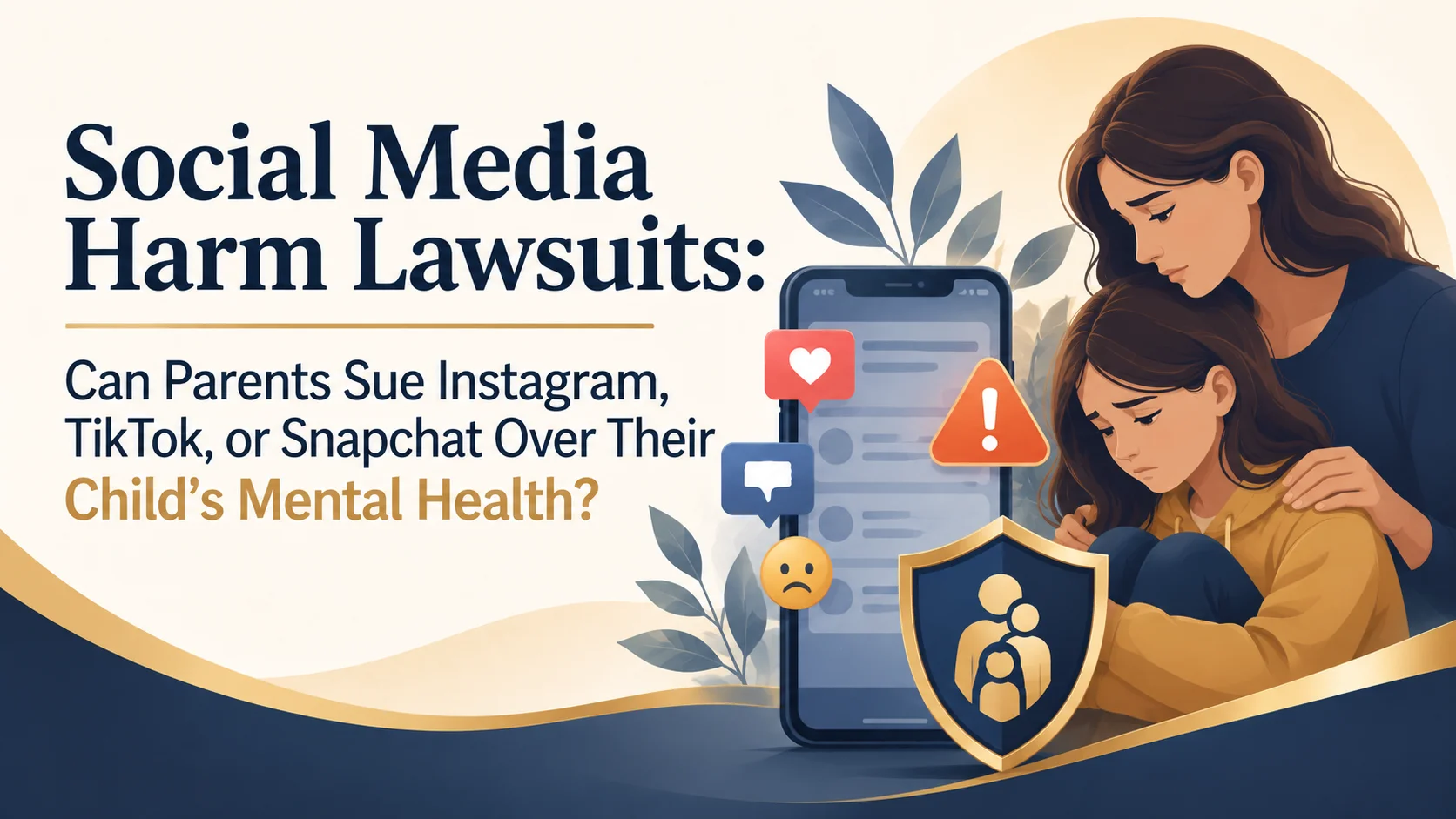
Social Media Harm Lawsuits: Can Parents Sue Instagram, TikTok, or Snapchat Over Their Child’s Mental Health?
For modern parents, navigating the digital landscape feels like walking a tightrope without a net. You hand your child a smartphone so they can stay connected with friends, coordinate school projects, and remain reachable in emergencies. Yet, that glowing screen also acts as a portal to a vast, complex ecosystem designed to capture and hold human attention. Over the past few years, a growing chorus of families has raised the alarm, suggesting that the very design of platforms like Instagram, TikTok, and Snapchat is profoundly unsafe for developing adolescent minds. This concern has moved swiftly from dinner-table conversations and school board meetings straight into the federal court system.
If you have been watching the news lately, you have likely seen headlines about a massive wave of litigation directed at major tech conglomerates. Thousands of families across the country are stepping forward, asking a fundamentally groundbreaking question: when a digital product allegedly causes severe psychological distress in minors, can the companies behind that product be held legally accountable? These emerging lawsuits allege that tech giants intentionally prioritized user engagement and profit over the well-being of young, vulnerable users. Instead of simply blaming the content created by other users, these legal actions take aim at the underlying architecture of the apps themselves—the algorithms, the notification systems, and the endless scrolling features.
This article explores the evolving landscape of this litigation. We will examine the core legal arguments being tested, the specific types of psychological impact families are reporting, the rigorous evidence required to build a case, and the substantial legal hurdles that stand in the way. Whether you are actively worried about your own child’s screen time or simply trying to understand the intersection of technology and law, this overview provides a detailed look at one of the most consequential legal battles of our time.
Understanding Our Legal Review Process
This educational overview has been compiled by our editorial team of legal analysts, relying on a synthesis of publicly available federal court dockets, ongoing multidistrict litigation (MDL) filings, and current trends in product liability law. Our goal is to translate complex legal theories into accessible, neutral information for families. We continuously monitor the shifting landscape of tech liability and digital privacy to provide readers with an objective, up-to-date framework of how the American judicial system is handling novel claims regarding adolescent internet use. None of the information contained herein constitutes formal legal or medical advice.
The General Legal Theory: Product Design and Addictive Features
To understand how a social media lawsuit works, it is crucial to understand that these families are not primarily suing over a specific offensive video, a mean comment, or a harmful photograph. Historically, holding a tech company liable for what its users post has been nearly impossible. Instead, plaintiffs’ attorneys have developed a novel approach rooted in traditional product liability law. They are arguing that the social media platforms themselves are defectively designed products.
Product liability is the area of law that holds manufacturers accountable when they release a dangerous physical item into the market—like a car with faulty brakes or a child’s toy painted with toxic lead. In these emerging tech cases, the legal argument being tested in courts is that software applications and algorithms should be treated as products subject to those same safety standards.
The core of the legal theory revolves around the concept of “addictive design.” Plaintiffs allege that social media companies engineered their platforms to manipulate the dopamine systems of the human brain, particularly exploiting the underdeveloped impulse control of teenagers. The lawsuits point to several specific features that are allegedly designed to maximize “time on device” at the expense of user health. These include infinite scroll (which eliminates natural stopping cues), intermittent variable rewards (the unpredictable nature of receiving “likes” and notifications, mimicking the psychological pull of a slot machine), and auto-playing videos that keep content moving without user initiation.
Furthermore, plaintiffs raise allegations of a “failure to warn.” In traditional product liability, if a company knows its product carries a hidden risk, it has a legal duty to warn consumers. Lawsuits allege that major tech firms possessed internal research indicating their platforms were exacerbating body image issues, anxiety, and depression among minors, yet chose to conceal this information from the public and parents. They argue that these companies marketed their platforms as safe spaces for connection while allegedly knowing the algorithms were actively steering teenagers toward rabbit holes of harmful content. It is important to remember that these are currently legal arguments being aggressively tested and debated in federal and state courts; they do not yet represent established, settled law.
What Kinds of Harm Are Generally Alleged?
The damages claimed in a social media harm claim go far beyond standard teenage moodiness or temporary distraction. Families are coming forward with allegations of severe, life-altering psychological and sometimes physical consequences tied directly to their children’s compulsive use of these apps. Because adolescent brains are still in a critical phase of development, plaintiffs argue that minors are uniquely susceptible to the algorithmic pressures of social comparison and social exclusion.
One of the most frequently alleged harms is the rapid onset of severe anxiety and clinical depression. Parents claim that the constant barrage of curated, heavily edited images creates an unreachable standard of perfection, leading to deep feelings of inadequacy and isolation. The algorithmic feed, plaintiffs argue, learns what captures a teenager’s attention and relentlessly serves them similar content. If a child lingers on a sad post, the algorithm may quickly inundate them with depressive content, allegedly creating a downward emotional spiral that the child cannot escape.
Sleep disruption is another major component of these claims. The lawsuits allege that features like read receipts, disappearing messages, and incessant push notifications are designed to create a false sense of urgency. Teenagers feel compelled to stay awake through the night to maintain “streaks” or monitor social dynamics, leading to chronic sleep deprivation. This lack of rest, in turn, severely exacerbates underlying mental health vulnerabilities, drops in academic performance, and aggressive mood swings.
More severe allegations involve the development of eating disorders and body dysmorphia. Plaintiffs claim that algorithmic curation often pushes diet-focused, pro-anorexia, or extreme fitness content to young girls and boys, warping their perception of a healthy body. Additionally, many lawsuits allege that the addictive loop of the platforms has led to incidents of self-harm and, in the most tragic cases, suicidal ideation or suicide. The overarching narrative presented in the litigation is one of behavioral addiction—where the minor loses the ability to self-regulate their use, resulting in a cascade of documented psychiatric and physical breakdowns. Again, within the context of the litigation, these harms are framed as allegations that the plaintiffs must ultimately prove were caused by the platforms’ design, rather than being accepted as proven, universal medical facts by the courts.
Who May Generally Be Eligible to Explore a Claim?
Not every parent who is frustrated with their teenager’s screen time has the foundation for a legal claim. Because of the intensive nature of mass tort and product liability litigation, the criteria for exploring a potential lawsuit are highly specific. Generally, eligibility requires a documented, tangible injury that a legal professional believes can be traced back to the usage of the product.
Typically, the person exploring the claim must be the parent or legal guardian of a minor (or a young adult who suffered the harm while they were a minor). The core requirement is that the child must have experienced a severe, documented mental health impact. Attorneys evaluating these cases are usually looking for situations where the child’s distress escalated to the point of requiring professional medical or psychiatric intervention. A general decline in grades or a bad attitude is rarely sufficient for a product liability claim. Instead, eligibility usually centers around formal diagnoses—such as clinical depression, severe anxiety disorders, eating disorders (like anorexia nervosa or bulimia), or instances where the child required hospitalization, inpatient treatment, or intensive outpatient therapy.
Crucially, there must be a plausible connection between the diagnosed harm and the specific use of the social media platforms. Attorneys will evaluate whether the child’s timeline of app usage correlates with the onset or sudden worsening of their mental health crisis. They will also look at whether the child exhibited classic signs of compulsive use or behavioral addiction, such as extreme withdrawal symptoms when the device was taken away, sneaking access to the apps late at night, or abandoning previously enjoyed real-world activities in favor of screen time.
Because state laws regarding the statute of limitations (the legal deadline to file a lawsuit) vary wildly, and because the legal standards for proving product liability differ from jurisdiction to jurisdiction, eligibility is not a one-size-fits-all formula. Any parent believing their child fits this profile must have their specific circumstances evaluated by a licensed personal injury or mass tort attorney who is actively tracking this multidistrict litigation.
What Evidence Matters in These Cases?
If a family decides to move forward in suing social media companies, they quickly learn that proving a product design caused a psychological injury requires a massive, coordinated evidentiary effort. Unlike a car crash where the damage is visible and immediate, mental health decline is gradual and multifaceted. Building a compelling case requires a dense paper trail that connects the digital world to the clinical reality.
The first major pillar of evidence is digital usage data. Plaintiffs’ attorneys need to establish exactly how much time the minor spent on the platforms, when they were active, and what specific features they interacted with. This often involves downloading comprehensive user data archives directly from the platforms, which can show timestamps of late-night scrolling, engagement with specific algorithms, and the sheer volume of notifications received. Screen Time logs from the child’s smartphone, internet router histories, and communication records are also heavily scrutinized to prove the compulsive nature of the usage.
The second, and perhaps most vital, pillar consists of comprehensive medical and psychological records. Plaintiffs cannot simply assert that their child was depressed; they must provide clinical proof. This includes notes from pediatricians, psychiatrists, therapists, and school counselors. These records are used to establish a clear medical diagnosis, document the severity of the symptoms, and outline the treatments required. Hospital intake forms, discharge summaries from behavioral health centers, and pharmacy records for psychiatric medications all serve as critical evidence.
The third pillar is the timeline. Attorneys must meticulously map the digital data against the medical records to establish a chronological narrative. They are looking to demonstrate that before heavy platform use, the child was generally healthy, and that the escalation of app usage directly preceded the mental health crisis. School records, including report cards, attendance logs, and disciplinary notes, are frequently used to show a distinct “before and after” picture of the child’s functioning. Finally, personal testimonies from parents, teachers, and the minors themselves are gathered to provide the human context behind the data, illustrating the daily reality of the alleged addiction.
How This Differs from an Ordinary Personal Injury Claim
When most people think of a personal injury lawsuit, they picture a slip-and-fall at a grocery store, a dog bite, or an intersection collision. In those traditional cases, the path from cause to effect is usually linear and easy for a jury to understand. The store left a puddle on the floor, the customer slipped, and the customer broke their arm. The duty of care, the breach of that duty, and the resulting physical injury are all relatively straightforward to connect.
Litigating a social media harm claim is an entirely different legal beast. First, the injury is largely invisible. Psychological and emotional harms, while devastating, cannot be captured on an X-ray. Quantifying the financial and emotional damages of severe teenage anxiety or an eating disorder requires complex expert testimony from psychiatrists and economists, projecting how the trauma will affect the child’s future earning capacity and quality of life over decades.
Second, ordinary personal injury cases usually involve a single, localized defendant—the distracted driver or the negligent store owner. Social media cases involve taking on some of the wealthiest, most technologically advanced, and well-resourced multinational corporations in human history. These companies employ massive legal teams dedicated to defending their products and protecting their proprietary algorithms.
Third, the mechanics of the harm are decentralized. A car crash happens in seconds; social media harm allegedly happens over thousands of hours of subtle, algorithmic micro-interactions. Proving that an app’s underlying code is “defective” requires plaintiffs to retain specialized software engineers, data scientists, and psychologists who can reverse-engineer how the platform operates and explain its impact on the adolescent brain to a judge and jury. Furthermore, these cases are often grouped together in multidistrict litigation (MDL) to handle the sheer volume of plaintiffs efficiently. This means your individual family’s case becomes part of a massive, consolidated legal machine, progressing at a pace dictated by federal judges managing thousands of similar claims nationwide.
Legal Hurdles These Cases Face
The path to holding tech companies accountable is fraught with unprecedented legal obstacles. The defendants are mounting vigorous defenses, relying on robust legal precedents that have shielded the tech industry for decades. Understanding these hurdles is essential for any family considering litigation, as success is far from guaranteed.
The most formidable shield the platforms hold is Section 230 of the Communications Decency Act of 1996. This foundational piece of internet law states that “No provider or user of an interactive computer service shall be treated as the publisher or speaker of any information provided by another information content provider.” For nearly thirty years, courts have interpreted this to mean that platforms cannot be sued for the harmful things their users post. If a teenager is cyberbullied, Section 230 generally protects the platform from being sued for hosting the bully’s words. To survive dismissal, plaintiffs must successfully convince judges that they are not suing over the content created by users, but over the design of the product itself (e.g., the algorithm that amplified the bullying or the notifications that kept the child awake). Distinguishing between the content and the design is a razor-thin legal wire, and courts are currently wrestling with exactly where to draw that line.
Another massive hurdle is the First Amendment. Social media companies argue that the way they curate, organize, and display content is a form of editorial discretion, which is protected as free speech. They contend that algorithmic recommendations are essentially the platform expressing an opinion on what the user might want to see. If courts rule that algorithms are protected speech, it would severely undercut the plaintiffs’ product liability theories.
Finally, there is the immense challenge of proving “proximate causation.” Even if a jury agrees that the platform is addictive and that the child is suffering from depression, the plaintiff must prove that the platform caused the depression. Adolescence is inherently a time of hormonal changes, social pressures, academic stress, and shifting family dynamics. Tech companies will aggressively argue that a child’s mental health struggles were caused by the pandemic, family issues, genetics, or school bullying, rather than their software. Disentangling the impact of an app from the chaotic reality of teenage life requires bulletproof expert testimony and remains one of the most difficult evidentiary burdens for plaintiffs to overcome.
Frequently Asked Questions (FAQ)
1. Is there a class action lawsuit for social media addiction?
While you may hear the term “class action” used casually, the current federal litigation is primarily organized as Multidistrict Litigation (MDL). In a class action, one or a few plaintiffs represent a massive group, and any settlement is split among the class. In an MDL, cases are consolidated in one federal court for the pre-trial discovery process to save time and resources, but each plaintiff’s case remains legally separate. Each family must still prove their specific individual injuries.
2. How much does it cost to hire a lawyer for a social media lawsuit?
The vast majority of attorneys handling these complex product liability and mass tort cases work on a contingency fee basis. This means the family does not pay any upfront hourly rates or out-of-pocket retainer fees. Instead, the law firm advances the immense costs of the litigation, and if they secure a settlement or jury verdict in your favor, they take a predetermined percentage of the recovery. If the case is unsuccessful, you typically owe the attorney nothing for their time.
3. Will my child have to testify in court?
It is a valid concern for parents who do not want to subject an already fragile child to a grueling cross-examination. Because these cases are in the early stages and consolidated in an MDL, it is highly unlikely that every single child will go to trial. Only a handful of “bellwether” (test) cases actually go before a jury. However, if you file a lawsuit, your child may eventually need to provide a deposition (sworn out-of-court testimony) or submit to an independent medical examination requested by the defense. Your attorney’s job is to protect your child as much as legally possible throughout this process.
4. Can I sue if my child just spends too much time on their phone but has no diagnosis?
Generally, no. A legal claim for product liability requires proof of tangible, compensable damages. Frustration over excessive screen time, arguments about putting the phone away at dinner, or a slight drop in academic focus, while highly stressful for a family, do not typically rise to the level of a legally actionable injury. The lawsuits currently progressing through the courts are focused on severe, documented psychological or physical harms that have required professional medical intervention.
5. Are the tech companies changing their platforms because of the lawsuits?
While the tech companies publicly deny the allegations in the litigation, some platforms have recently rolled out new features marketed as “parental controls” or “teen safety updates,” such as default screen time limits for minors or night-time notification muting. Plaintiffs’ attorneys often argue these changes are too little, too late, while the companies maintain they are part of an ongoing commitment to user safety. Whether these changes impact the ongoing litigation remains to be seen.
6. How long will this legal process take?
Mass tort litigation against multinational corporations is a marathon, not a sprint. These cases involve millions of pages of internal corporate documents, battles over highly technical code, and complex constitutional arguments. It is common for this type of consolidated litigation to take several years before reaching bellwether trials or potential global settlement discussions. Families entering this process should be prepared for a timeline measured in years.
Disclaimer: The information provided in this article is intended for general educational and informational purposes only and does not constitute legal, medical, or psychological advice. The legal theories, allegations, and court proceedings discussed are part of an actively evolving area of law, and outcomes are never guaranteed. The claims made against social media companies remain allegations being tested in court, not established legal or medical facts. If you believe your child has been harmed by social media, you should consult with a licensed, qualified attorney in your jurisdiction to discuss your specific legal options. If you or your child are experiencing a mental health crisis, please seek immediate assistance from a qualified healthcare provider or mental health professional, or contact emergency services.